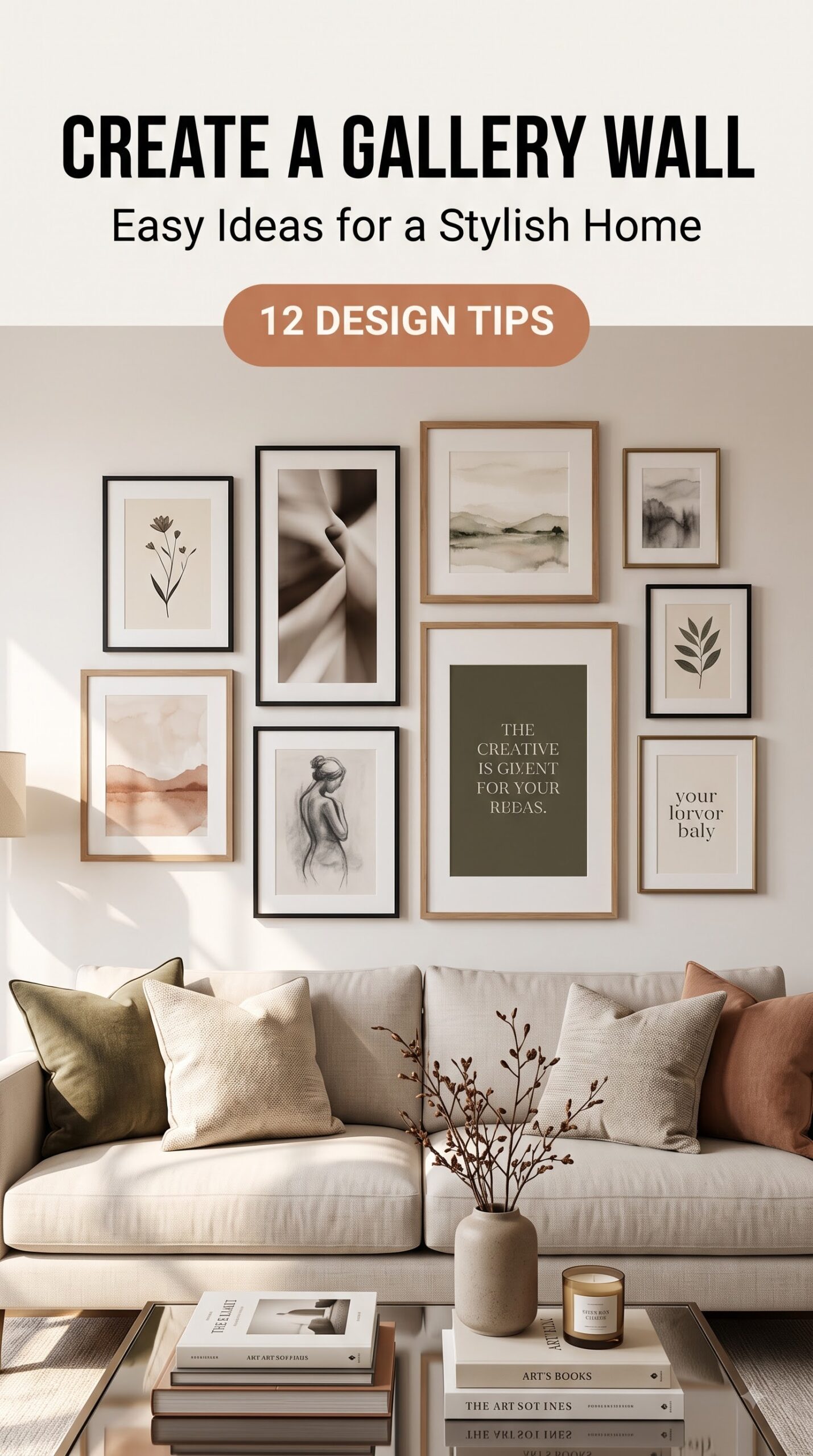

Introduction
A blank wall can make a room feel unfinished. One of the easiest ways to give it personality is to create a gallery wall.
A gallery wall brings together framed artwork, photographs, prints, and meaningful objects to create one larger visual display. It can be perfectly symmetrical, relaxed and eclectic, or somewhere in between.
The secret isn’t having expensive artwork. It’s planning the arrangement, choosing a visual connection between the pieces, and keeping the spacing intentional. Current decorating guidance also emphasizes personal artwork, curated prints, and family photographs over generic wall signs for a more authentic look.


7
Image prompt: Premium realistic editorial photograph of a sophisticated modern American living room with a beautiful gallery wall above a neutral sofa, curated framed artwork, photography and botanical prints, black and natural wood frames, cream beige and muted earthy tones, warm natural window light, high-end interior design magazine photography, realistic proportions, no text.
What Is a Gallery Wall?
A gallery wall is a collection of multiple decorative pieces arranged together as one intentional composition.
You can include:
- Framed artwork
- Family photographs
- Travel photos
- Botanical prints
- Vintage artwork
- Children’s artwork
- Abstract prints
- Small mirrors
- Decorative objects
- Personal memorabilia
The pieces don’t have to match perfectly. What matters is having a visual connection between them through color, frame style, subject, or overall mood.
Why Create a Gallery Wall?
A well-planned gallery wall can help:
- Fill a large blank wall
- Add personality to your home
- Display meaningful photographs
- Create a focal point
- Make a room feel more finished
- Bring different colors together
- Showcase your personal style
The goal is to make the collection look intentional rather than like several unrelated frames placed randomly on a wall.


7
Image prompt: Premium realistic collage-style interior photography showing three stylish American homes with different gallery wall approaches: minimalist, eclectic and personal family-photo style, sophisticated neutral interiors, natural light, editorial home decor aesthetic.
12 Gallery Wall Ideas to Try
1. Create a Simple Grid Gallery Wall
If this is your first gallery wall, a grid is one of the easiest designs to get right.
Use frames that are the same size or very similar and arrange them in straight rows.
This style works particularly well with:
- Family portraits
- Black-and-white photography
- Botanical prints
- Travel photography
- A collection of similar artwork
The important part is keeping the horizontal and vertical spacing consistent.


7
Image prompt: Realistic premium interior photograph of a modern American living room with six matching black frames arranged in a perfectly aligned 2-by-3 grid above a neutral sofa, coordinated minimalist artwork, even spacing, warm natural light, sophisticated editorial photography.
2. Try an Organic Gallery Wall
Want something more relaxed?
Use different frame sizes and artwork orientations to create an organic arrangement.
Start with one larger piece as your anchor and build around it.
The arrangement should still have balance even though it isn’t symmetrical.


7
Image prompt: High-end realistic American living room featuring an organic salon-style gallery wall with mixed frame sizes, black, natural wood and brass frames, photography, abstract art and botanical prints, balanced asymmetrical arrangement, neutral sofa, warm daylight.
3. Mix Family Photos With Artwork
Your gallery wall doesn’t need to be entirely decorative art.
Combine family photographs with artwork to make the wall feel personal.
For example:
Large artwork + family portrait + travel photo + botanical print + smaller photograph
Using similar colors or consistent frames will help the collection feel cohesive.


7
Image prompt: Warm realistic American living room featuring a sophisticated gallery wall combining family photographs, travel photos, botanical prints and abstract artwork, coordinated frames, neutral sofa, natural daylight, personal yet polished interior photography.
4. Use One Large Statement Piece
You don’t need 15 small frames to make an impact.
Start with one large statement artwork and surround it with smaller pieces.
The large piece becomes the visual anchor while the smaller frames provide supporting detail.


5
Image prompt: Premium realistic photograph of a modern American living room with one large statement artwork as the center of a gallery wall, smaller framed photographs and prints arranged around it, elegant neutral sofa, warm natural light, sophisticated interior magazine style.
5. Choose a Consistent Color Palette
Your artwork doesn’t need identical colors, but repeating a few shades can make the whole wall feel connected.
Try a palette such as:
| Color Palette | Overall Feel |
|---|---|
| Black + white + beige | Modern |
| Cream + olive + brown | Natural |
| Terracotta + beige + black | Warm |
| Navy + cream + brown | Classic |
| Sage + white + wood | Relaxed |
A limited palette can be especially helpful when you’re mixing different frame styles.


7
Image prompt: Sophisticated gallery wall in a modern American home using artwork in cream, black, olive green, warm brown and muted terracotta, coordinated frames, neutral wall and sofa, natural daylight, premium editorial interior photography.
6. Plan the Gallery Wall on the Floor
Before putting holes in the wall, lay your frames on the floor.
This gives you the freedom to experiment.
Try different arrangements until you find one that looks balanced.
Take a photo of the final arrangement so you have a reference when hanging the pieces.
Planning the layout before drilling is a commonly recommended approach because it lets you adjust the composition without damaging the wall.


7
Image prompt: Realistic DIY home decor scene with multiple framed artworks arranged on a clean floor before installation, measuring tape, pencil and level nearby, modern American home, natural daylight, practical editorial photography.
7. Create a Gallery Wall Above the Sofa
The space above a sofa is one of the most popular locations.
The artwork grouping should feel connected to the furniture below it rather than floating independently.
A good starting point is to keep the overall gallery visually narrower than or roughly aligned with the sofa width.


8
Image prompt: High-end realistic modern American living room with a balanced gallery wall above a large cream sofa, mixed black and natural wood frames, varied artwork sizes, warm neutral decor, natural sunlight, sophisticated editorial interior photography.
8. Mix Frame Styles
Matching frames create a clean, formal appearance.
Mixed frames create a more collected look.
You could combine:
- Matte black
- Natural wood
- White
- Brass
- Dark walnut
If you’re mixing several frame finishes, repeat one finish throughout the arrangement so the wall still feels connected.


7
Image prompt: Sophisticated American gallery wall using a coordinated mixture of matte black, natural wood and subtle brass frames, varied artwork and photography, balanced spacing, neutral interior, warm daylight, premium editorial home photography.
9. Create a Hallway Gallery Wall
A hallway is an excellent place for artwork because long blank walls can otherwise feel forgotten.
For a narrow hallway, consider:
- A horizontal row
- A small grid
- Similarly sized frames
Keep the arrangement compact enough that it doesn’t interfere with movement through the space.


6
Image prompt: Elegant modern American hallway with a curated gallery wall of framed photography and artwork, evenly spaced frames, warm neutral walls, wood flooring, natural light, sophisticated home magazine photography.
10. Create a Staircase Gallery Wall
A staircase naturally gives you a diagonal line to follow.
Rather than forcing the artwork into a rectangle, arrange the frames so the overall display rises with the staircase.
Family photographs work particularly well here.


7
Image prompt: Premium realistic American home staircase with a gallery wall following the diagonal of the stairs, framed family photographs and artwork, coordinated frames, warm neutral walls, natural daylight, elegant editorial interior photography.
11. Use a Picture Ledge
A picture ledge gives you a gallery-wall look without requiring every frame to be permanently mounted.
Lean artwork against the wall and layer smaller pieces in front.
This makes it easy to change the arrangement whenever you want.


6
Image prompt: Stylish modern American living room with a long picture ledge displaying layered framed artwork, family photos and small decorative objects, neutral sofa, warm wood accents, natural daylight, sophisticated editorial home decor photography.
12. Make It Personal
The best gallery walls often tell a story.
You could include:
- Family photographs
- Vacation memories
- Favorite artwork
- Children’s drawings
- Vintage postcards
- Maps
- Meaningful quotes
- Personal collections
A few personal pieces can make the entire arrangement feel much more authentic.
How to Create a Gallery Wall Step by Step
Step 1: Choose Your Wall
Decide where the gallery will go.
Popular locations include:
- Living room
- Bedroom
- Hallway
- Staircase
- Dining room
- Home office
- Entryway
Step 2: Measure the Space
Measure the available wall area.
Also measure the furniture beneath it if applicable.
This prevents you from creating a gallery that’s too small or too large.
Step 3: Choose Your Artwork
Collect the pieces you want to use.
Think about:
- Color
- Size
- Subject
- Orientation
- Personal meaning
Step 4: Decide on a Layout
Choose between a:
Grid → clean and structured
Organic cluster → relaxed and eclectic
Linear row → simple and modern
Staircase layout → follows the architecture
Picture ledge → flexible and easy to change
Step 5: Arrange Everything on the Floor
Put the frames together before hanging them.
Adjust until the entire group feels balanced.
Step 6: Create Paper Templates
For extra precision, trace each frame onto paper and cut out the shapes.
Tape the paper templates to the wall.
This allows you to test the arrangement before drilling.


7
Image prompt: Realistic American home decorating scene showing paper templates taped to a wall to plan a gallery wall, measuring tape and pencil visible, framed artwork on the floor, bright natural light, practical DIY editorial photography.
Step 7: Check the Spacing
A common starting point is around 2–3 inches between frames. Consistency is more important than obsessing over one exact measurement.
Step 8: Hang the Frames
Use appropriate hardware for your wall type and the weight of each frame.
Start from the center or main anchor and work outward.
Step 9: Step Back
Don’t judge the wall from only a few feet away.
Step back across the room and look at the arrangement as a whole.
How Much Space Should Be Between Gallery Wall Frames?
Spacing has a major effect on how polished the finished wall looks.
A practical starting range is 2–3 inches between frames. Smaller frames can sometimes work with tighter spacing, while larger artwork may benefit from slightly more breathing room.
The most important rule is:
Keep your spacing consistent.
Uneven gaps can make even beautiful artwork look randomly arranged.
How High Should a Gallery Wall Be?
Instead of measuring every frame individually from the floor, think of the entire gallery as one composition.
A commonly used guideline is to center the overall arrangement around eye level, approximately 57–60 inches from the floor to the center of the grouping. Furniture and room proportions should also influence the final placement.
For a gallery above a sofa, console, or other furniture, leave enough breathing room so the artwork feels connected to the furniture without appearing cramped.
How to Choose Gallery Wall Frames
You have two main options.
Matching Frames
Use the same frame throughout the arrangement.
Best for:
- Modern homes
- Grid layouts
- Black-and-white photographs
- Minimalist interiors
Mixed Frames
Combine two or three finishes.
Best for:
- Eclectic interiors
- Family photo collections
- Collected-over-time looks
- Organic gallery walls
A mixture of frame styles can work well when another element—such as artwork color or matting—creates cohesion.


7
Image prompt: Close-up premium interior photograph comparing coordinated black frames, natural wood frames and subtle brass frames arranged beautifully in a sophisticated American gallery wall, realistic materials, warm natural lighting, editorial home decor photography.
How to Choose Artwork
You don’t need to buy everything from the same collection.
Try combining:
- Affordable art prints
- Personal photographs
- Vintage artwork
- Botanical illustrations
- Abstract art
- Travel photography
- Children’s artwork
A Simple Formula
Start with:
1 large anchor + 2–3 medium pieces + several smaller pieces
Then adjust the arrangement based on the size of your wall.
Gallery Wall Ideas by Room
| Room | Good Layout | Artwork Ideas |
|---|---|---|
| Living Room | Organic or grid | Art, family photos, photography |
| Bedroom | Symmetrical | Calm artwork, personal photos |
| Hallway | Linear row | Travel photos, small prints |
| Staircase | Ascending | Family memories |
| Dining Room | Grid or row | Botanical or food artwork |
| Home Office | Grid | Photography, maps, illustrations |
| Entryway | Small cluster | Art, mirror, personal photos |
Common Gallery Wall Mistakes
1. Hanging Frames Too Far Apart
Large gaps can make the pieces look disconnected.
2. Using Too Many Unrelated Frames
Variation is good, but too much visual competition can make the wall feel chaotic.
3. Skipping the Planning Stage
Always test your arrangement before making permanent holes.
4. Ignoring Scale
A tiny gallery wall can disappear above a large sofa, while an oversized arrangement can overwhelm a small room.
5. Making Everything Too Perfect
If you want an eclectic look, some variation can actually make the wall feel more natural.
Gallery Wall Checklist
- Choose the wall
- Measure the available space
- Measure nearby furniture
- Choose a gallery style
- Collect artwork
- Select frames
- Choose a color palette
- Arrange everything on the floor
- Photograph the arrangement
- Create paper templates
- Check spacing
- Mark hanging points
- Use appropriate hardware
- Hang from the center outward
- Step back and make final adjustments
Frequently Asked Questions
How many pictures do you need for a gallery wall?
There is no fixed number. Three pieces can create a small display, while larger walls may need six, eight, ten, or more pieces.
Should all gallery wall frames match?
No. Matching frames create a clean, formal appearance, while mixed frames can create a more collected and personal look.
What is the best spacing for a gallery wall?
A useful starting point is 2–3 inches between frames, with consistent spacing throughout the arrangement.
Should a gallery wall be centered over a sofa?
The overall arrangement should generally feel balanced with the sofa underneath it. Consider the sofa width and the size of the gallery as a whole.
What should I put in a gallery wall?
You can use photographs, artwork, botanical prints, vintage pieces, children’s art, maps, mirrors, and other meaningful objects.
Can renters create a gallery wall?
Yes. For lightweight artwork, appropriate removable hanging products may be an option, provided you follow the product’s weight and wall-surface requirements.
Final Thoughts
Learning how to create a gallery wall doesn’t require professional design skills.
Start with artwork you genuinely like. Pick a simple layout, establish a visual connection between your pieces, plan the arrangement on the floor, and keep your spacing consistent.
Whether you choose a perfectly aligned grid or a relaxed collection of family photographs and artwork, the finished wall should reflect your home and your personality.
A blank wall is an opportunity. Gather your favorite pieces, plan before you hang, and turn that empty space into something worth looking at every day.