
SEO Title: Scent Stacking: How to Layer Perfumes and Create Your Own Signature Scent
Meta Description: Scent stacking is one of 2026’s biggest fragrance trends. Learn how perfume layering works, which scent families pair well, and how to create your own fragrance combinations.
Focus Keyword: scent stacking
Secondary Keywords:
perfume layering, scent layering combinations, how to layer perfumes, fragrance layering guide, perfume combinations, signature scent, fragrance wardrobe, perfume notes
URL Slug:/scent-stacking-perfume-layering-guide/
Scent Stacking: Why Everyone Is Layering Perfumes in 2026
What if your next favorite perfume isn’t actually one perfume?
What if it’s two?
Or three?
That’s the idea behind scent stacking, one of the fragrance world’s most talked-about trends in 2026.
Instead of spraying a single fragrance and calling it your signature scent, people are combining different fragrances, body products, oils and mists to create a scent profile that feels more personal.
Pinterest’s 2026 trend data shows just how quickly interest is growing:
- Niche perfume collections: +500%
- Perfume layering combinations: +125%
- Scent layering: +75%
- Perfume notes: +80%
- Signature scent: +45%
Vogue’s 2026 fragrance coverage describes the same broader shift: consumers are becoming more willing to explore, layer and treat fragrance as something that can change with mood, season or occasion instead of committing to one permanent signature scent.
And that’s what makes scent stacking so interesting.
You’re not simply wearing perfume.
You’re building a scent.
What Is Scent Stacking?
Scent stacking means using more than one fragrance product or scent layer to create a combined fragrance experience.
That might mean:
body wash → body lotion → body mist → perfume
Or:
perfume oil → eau de parfum
Or simply:
fragrance A → fragrance B
The goal is not necessarily to make the strongest smell possible.
It’s to create something more personalized.
British Vogue’s 2026 guide describes layering as an increasingly popular way to make fragrance feel more individual, while recommending experimentation with different formats, seasons and scent profiles.
Think of it like getting dressed.
You don’t wear the same outfit every day.
So why should your fragrance always be exactly the same?
📸 IMAGE — PLACE HERE
Fragrance layering is increasingly being presented as a personalized ritual rather than a single-scent routine.
Why Is Scent Stacking Suddenly So Popular?
The answer is partly about personalization.
For years, fragrance culture often revolved around finding one signature scent.
You bought it.
You wore it.
People associated you with it.
Now that idea is changing.
Vogue reported in 2026 that the traditional idea of one fixed signature scent is becoming less relevant as consumers experiment with fragrance combinations and build what the industry increasingly describes as a fragrance wardrobe.
And Pinterest’s own trend data points in the same direction, with niche perfume collections showing a huge increase in search activity.
The New Question Is:
Not:
“What’s your perfume?”
But:
“What are you wearing today?”
Your Fragrance Can Match Your Mood
That’s one of the biggest attractions of layering.
You can create different combinations for different situations.
Fresh Day
Citrus + musk
Cozy Evening
Vanilla + amber
Romantic
Rose + soft woods
Clean
Green tea + musk
Warm & Sensual
Vanilla + sandalwood
The possibilities become much larger once you stop thinking about perfumes as individual products and start thinking about them as building blocks.
The Fragrance Families You Need to Know
You don’t need to become a perfume expert.
Start by learning a few broad scent families.
Citrus
Think:
Lemon, bergamot, orange, grapefruit.
These often bring brightness and freshness.
Floral
Rose, jasmine, orange blossom, violet and other flowers.
These can add softness or a more romantic character.
Fruity
Peach, pear, cherry, berries, fig and other fruit notes.
These can add sweetness or brightness.
Woody
Sandalwood, cedar, vetiver and related woody materials.
These often add warmth and depth.
Musky
Soft, clean, skin-like or powdery effects are common descriptions associated with musk.
Gourmand
Vanilla, caramel, chocolate, coffee and similar edible-inspired notes.
These can make a fragrance feel warmer and sweeter.
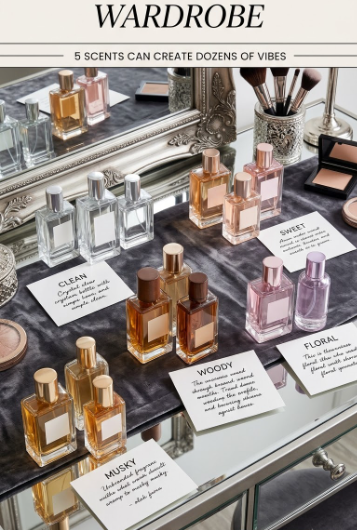
📸 IMAGE — PLACE HERE
Visual fragrance collections can be grouped by scent family or mood, making experimentation easier.
7 Perfume Layering Combinations to Try
Here’s where scent stacking gets fun.
These combinations are starting points, not strict rules. Fragrance reacts differently depending on the formulas and the wearer’s skin, so test combinations before wearing them for an important occasion. British Vogue similarly recommends experimenting at home first.
1. Citrus + Musk
This is one of the easiest combinations for someone new to layering.
The citrus creates brightness.
The musk provides softness.
The result can feel clean and fresh without being overly sweet.
Great For:
Daytime.
Office settings.
Warm weather.
2. Vanilla + Amber
Want something warmer?
Try vanilla with amber.
The vanilla contributes sweetness while amber-style accords can add warmth and depth.
Great For:
Fall.
Evenings.
Cozy nights.
3. Rose + Wood
A floral note can become less traditionally sweet when paired with a woody fragrance.
Rose gives the combination softness.
Wood gives it structure.
Great For:
Dinner.
Date nights.
Dressier occasions.
4. Green Tea + Bergamot
This pairing takes freshness in a different direction.
Green tea can bring a soft green quality.
Bergamot adds citrus brightness.
Great For:
Morning.
Spring.
Summer.
Casual days.
5. Coconut + Sandalwood
This creates a creamy, warm combination.
Coconut gives a tropical softness.
Sandalwood adds a smooth woody foundation.
Current 2026 fragrance coverage also highlights coconut and sandalwood as a popular pairing for a warm, skin-like effect.
6. Fig + White Musk
Fig can add a slightly fruity, creamy character.
White musk can make the overall impression feel soft and clean.
The result can work particularly well when you want something less obviously sweet.
7. Vanilla + Tobacco
This is for people who prefer deeper, richer fragrance profiles.
Vanilla brings sweetness.
Tobacco-style notes can bring warmth and depth.
It can feel especially appropriate for colder weather and evening wear.
The Biggest Beginner Mistake
Don’t start by spraying five perfumes together.
That’s usually the fastest way to lose track of what you’re smelling.
Start with two.
That’s it.
Test:
A + B
Then:
A alone
Then:
B alone
This makes it much easier to understand what each fragrance contributes.
Does the Order Matter?
There isn’t one universal rule that every fragrance must follow.
However, layering guides commonly suggest starting with the more substantial or heavier scent and adding a lighter fragrance afterward, depending on the formulas.
British Vogue’s 2026 guide specifically notes that order and placement matter, while recommending experimentation rather than treating layering as a rigid formula.
A Simple Starting Method
Try:
Body cream → fragrance mist → perfume
or:
heavier fragrance → lighter fragrance
Then test how the combination develops on your skin.
Don’t Forget Body Products
Scent stacking doesn’t have to mean buying three expensive perfumes.
That’s one of the most interesting parts of the trend.
Your layers can include:
Body wash
Body lotion
Body oil
Body mist
Hair mist
Perfume oil
Eau de parfum
Vogue’s 2026 fragrance guide specifically describes layering across formats such as body care, hair mist, oils and traditional fragrance.
This makes the trend much more accessible.
You may already own everything you need.
📸 IMAGE — PLACE HERE
A modern fragrance routine can combine perfume with body products to build different scent profiles.
The “Fragrance Wardrobe” Method
Instead of having one giant perfume collection, organize your fragrances by mood.
Clean
Fresh, airy, musky.
Sweet
Vanilla, caramel, gourmand.
Romantic
Rose, jasmine, soft florals.
Warm
Amber, woods, spices.
Fresh
Citrus, green tea, aquatic-style notes.
Now you can choose your scent the same way you’d choose clothing.
Monday: Clean
Tuesday: Fresh
Friday night: Warm
Saturday: Sweet
Sunday: Romantic
There’s no need for one scent to do everything.
How to Find Your Personal Combination
Here’s the easiest experiment.
Take your two favorite fragrances.
Spray fragrance A on one wrist.
Spray fragrance B on the other.
Then try the combination according to the product instructions, using a small amount.
Wait.
Don’t judge it immediately.
Fragrance develops over time.
Then ask yourself:
Which one do I like alone?
Which combination feels more interesting?
Does one overpower the other?
Do I actually enjoy the result after it settles?
Keep notes.
You may eventually discover a combination that’s much more “you” than either perfume alone.
Why Niche Perfumes Are Getting Attention
Pinterest’s 2026 data shows niche perfume collection searches up 500%.
That is especially interesting because niche fragrance often encourages experimentation with unusual notes and less familiar scent profiles.
Instead of choosing the fragrance everyone recognizes, people can explore:
fig
incense
tea
moss
iris
salt
saffron
tobacco
leather
wood
That opens up a much larger creative playground.
A Simple Scent-Stacking Formula
Start with:
Base
A deeper or longer-lasting scent.
Think:
woods + amber + musk
Middle
Something that adds personality.
Think:
rose + vanilla + fig
Top
Something bright.
Think:
bergamot + citrus + green notes
You don’t have to use all three every time.
Two layers can be enough.
What NOT to Do
Don’t Mix Everything at Once
Too many scents can become difficult to distinguish.
Don’t Start With Heavy Spraying
Begin with small amounts.
You can always add more.
Don’t Assume a Combination Will Smell the Same on Everyone
Skin chemistry, product formulation and environment can change how fragrance develops.
Don’t Test a New Combination Right Before an Important Event
Try it at home first.
This is also consistent with British Vogue’s advice to experiment before wearing an unfamiliar combination out.
The Most Pinterest-Worthy Part of Scent Stacking
The trend isn’t only about smelling different.
It looks beautiful too.
A fragrance wardrobe creates incredible visuals:
multiple glass bottles,
body oils,
cream jars,
mist bottles,
perfume strips,
flowers,
citrus peels,
vanilla pods,
wood,
amber-colored liquids.
That’s exactly why this topic works so well as visual content.
The reader can immediately imagine the ritual.
And that’s what turns a beauty article into a Pinterest click.
FAQ
What does scent stacking mean?
Scent stacking means combining multiple fragrance layers—such as perfumes, body products, mists or oils—to create a personalized fragrance experience.
Is scent stacking a new trend?
The practice of layering fragrances is not new, but it has become a prominent 2026 fragrance trend. Pinterest reports strong increases in searches for niche perfume collections and perfume layering combinations, while Vogue describes a broader move toward personalized fragrance wardrobes.
How many perfumes should you layer?
Beginners should start with two fragrances so they can clearly understand how the combination develops.
What perfumes layer well together?
Scent families that complement one another can be a good starting point. Common combinations include citrus + musk, vanilla + amber, floral + wood and green + citrus.
Should you layer perfume on top of body lotion?
Yes, fragranced body products can be part of a scent-stacking routine. For sensitive skin, choose products according to your own tolerance and the manufacturer’s directions.
Can men use scent stacking?
Absolutely. Scent stacking is not limited to one gender. Vogue reported that the shift from a single signature scent toward fragrance rotation and layering is also occurring in men’s fragrance.
Does layering make perfume last longer?
It can change how fragrance develops and is perceived, but longevity depends on the individual products, formulation, skin and environment. Don’t assume that adding more fragrance automatically means longer wear.
Final Thoughts
For a long time, perfume was treated like a signature.
One bottle.
One identity.
One scent people remembered.
2026 is making that idea much more flexible.
Pinterest’s rising searches for perfume layering combinations and niche perfume collections, together with current Vogue coverage, point toward a fragrance culture built around experimentation and personalization rather than one fixed formula.
And that’s what makes scent stacking so much fun.
You don’t have to find the one perfect perfume.
You can create your own combination.
Today it might be:
vanilla + amber.
Tomorrow:
citrus + musk.
Next weekend:
rose + wood.
Your fragrance can change with your outfit, your mood, the weather or simply what you feel like wearing.
Don’t just find your signature scent. Build your own.