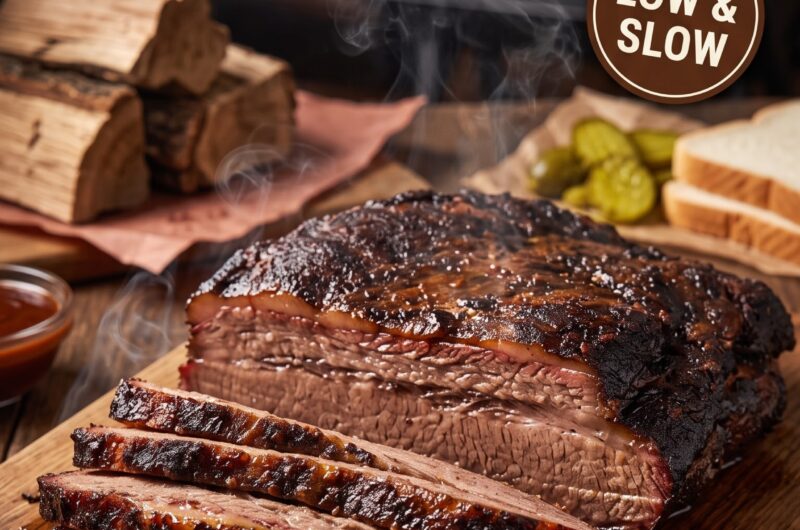

What Makes Texas BBQ Brisket Special?
Few barbecue dishes are as iconic as Texas BBQ brisket. A good brisket is all about patience: a beef brisket is seasoned simply, smoked over wood for hours, and cooked until the connective tissue has softened and the meat becomes tender.
Traditional Texas-style brisket often keeps the seasoning simple, allowing the beef and smoke to take center stage. The finished brisket should have a dark, flavorful bark on the outside and juicy, tender slices inside.


6
Image placement: Hero image directly below the introduction.
🥩 Ingredients You’ll Need
Texas-style brisket doesn’t require a long ingredient list.
| Ingredient | Amount |
|---|---|
| Whole beef brisket | 10–14 lb |
| Kosher salt | ¼ cup |
| Coarse black pepper | ¼ cup |
| Garlic powder | 1–2 tbsp, optional |
| Yellow mustard | Small amount, optional binder |
| Wood for smoking | As needed |
| Beef tallow | Optional |
The Brisket
A whole packer brisket contains two main sections: the flat and the point.
The flat is generally leaner, while the point contains more marbling and fat.
When shopping, look for a brisket with good marbling and a flexible feel rather than one that is extremely stiff.


6
🌶️ The Classic Texas Brisket Rub
A traditional Texas approach is surprisingly simple:
Salt + coarse black pepper
Many cooks use approximately equal parts salt and pepper, although the exact ratio can be adjusted based on the size of the brisket and personal preference.
Garlic powder can also be added if you prefer a little extra flavor.
Why Keep the Rub Simple?
Brisket spends many hours exposed to smoke. A simple seasoning lets the beef, rendered fat, and wood smoke remain prominent.
Step 1: Trim the Brisket
Place the cold brisket on a large cutting board with the fat side facing up.
Use a sharp boning or trimming knife to remove:
- Very thick areas of hard surface fat
- Loose pieces of meat
- Thin flaps that could burn
- Excessive fat around the edges
Don’t remove all the fat.
A reasonable layer of fat can help protect the meat during the long cooking process.
📸 IMAGE PROMPT — Trimming
AI image-generation prompt:
“Ultra-realistic close-up of a pitmaster carefully trimming a large whole packer beef brisket with a sharp boning knife on a professional wooden cutting board, visible marbling and fat cap, authentic Texas BBQ preparation, rustic smokehouse setting, natural warm lighting, premium editorial food photography, no text, no logo.”
Step 2: Season the Brisket
Pat the brisket dry with paper towels.
Apply a thin layer of yellow mustard if you want to use a binder. The mustard flavor will not dominate the finished brisket.
Generously season all sides with coarse kosher salt and coarse black pepper.
Press the seasoning gently onto the meat.


5
Step 3: Prepare the Smoker
Preheat your smoker and aim for approximately 225°F to 250°F.
Popular woods for brisket include:
- Post oak
- Oak
- Hickory
- Pecan
Texas barbecue is particularly associated with oak smoke, especially post oak.
Avoid producing heavy, dirty smoke. The goal is a steady stream of clean smoke rather than thick white clouds.
Step 4: Place the Brisket in the Smoker
Place the seasoned brisket in the smoker with the thicker portion positioned toward the hotter area of your smoker.
The exact orientation depends on your smoker’s heat source.
Insert a reliable meat thermometer into the thickest part of the brisket, avoiding large pockets of fat.
Close the smoker and let the cooking process begin.


8
Step 5: Build the Bark
The bark is one of the most desirable parts of Texas brisket.
During the early and middle stages of cooking, the surface gradually darkens as the seasoning, smoke, and meat proteins interact.
Try not to constantly open the smoker.
Every time you open the lid, heat and smoke escape.
Instead, monitor the smoker temperature and use a remote thermometer when possible.
🌡️ Understanding the Brisket Stall
At some point during a long brisket cook, the internal temperature may stop rising as quickly.
This is commonly called the stall.
Evaporation from the surface can cool the brisket while the smoker continues heating it.
Don’t panic if the temperature seems to plateau.
You can simply continue cooking until the brisket reaches the texture you want.
Step 6: Wrap or Don’t Wrap?
This is one of the biggest debates in brisket cooking.
Unwrapped Brisket
Leaving the brisket unwrapped allows the bark to develop directly in the smoke.
Pros:
- Strong bark
- More smoke exposure
- Traditional appearance
Cons:
- Longer cooking time
- Greater moisture loss risk
Wrapped Brisket
Wrapping the brisket in butcher paper or foil can speed up the cooking process and reduce moisture loss.
Butcher paper allows some airflow and helps preserve the bark.
Foil creates a tighter seal and can speed cooking further, although the bark may become softer.


5
Step 7: Cook Until Tender
Don’t rely on one exact internal temperature to determine when brisket is finished.
Temperature is useful as a guide, but tenderness is the better test.
Many briskets become probe-tender somewhere around the low 200s°F, but individual briskets vary.
Insert a thermometer probe or meat probe into several areas of the brisket.
When it slides in with little resistance, the brisket is approaching the texture you want.
Step 8: Rest the Brisket
This step is extremely important.
Remove the brisket from the smoker and let it rest before slicing.
A properly rested brisket allows its juices to redistribute and gives the meat time to settle.
Keep the brisket warm during the rest rather than leaving it exposed at room temperature for an extended period.


7
Step 9: Slice the Brisket Correctly
This is where many otherwise excellent briskets can go wrong.
The grain direction changes between the flat and point.
For the Flat
Slice across the grain into thin, even slices.
For the Point
The grain runs differently, so adjust the direction of your knife accordingly.
A sharp slicing knife makes the job much easier.
You want slices that hold together but are tender enough to pull apart easily.


8
🔥 How to Get Better Brisket Bark
If a dark, flavorful bark is your goal:
1. Keep the Seasoning Simple
Salt and coarse black pepper are enough for a classic approach.
2. Use Clean Smoke
Heavy, dirty smoke can create harsh flavors.
3. Don’t Wrap Too Early
Give the bark time to develop before wrapping.
4. Avoid Constant Spritzing
Opening the smoker repeatedly can extend cooking time.
5. Maintain Steady Heat
Large temperature swings make long cooks harder to manage.
🪵 Best Wood for Texas BBQ Brisket
| Wood | Flavor |
|---|---|
| Post oak | Balanced, classic Texas BBQ |
| Oak | Mild to medium smoke |
| Pecan | Slightly sweet and nutty |
| Hickory | Stronger, hearty smoke |
| Mesquite | Very bold; use carefully |
For a classic Texas-inspired brisket, post oak is an excellent choice.
How Long Does Brisket Take to Smoke?
This is one of the hardest questions to answer with a single number.
Cooking time depends on:
- Brisket size
- Thickness
- Fat content
- Smoker temperature
- Weather
- Smoker design
- Whether the brisket is wrapped
- Desired tenderness
Rather than cooking strictly by the clock, use the clock as a planning tool and temperature plus tenderness as your guide.
For a large whole brisket, plan for a long cooking window and build extra time into your schedule.
Common Texas Brisket Mistakes
Cutting the Brisket Too Soon
Skipping the resting period can make slicing more difficult.
Fix: Give the brisket adequate time to rest.
Cooking Only by Temperature
A specific number doesn’t guarantee tenderness.
Fix: Use temperature as a guide and check for probe tenderness.
Over-Trimming
Removing too much fat can leave portions of the brisket dry.
Fix: Trim away hard, excessive fat while leaving useful marbling and a reasonable fat layer.
Too Much Smoke
More smoke isn’t always better.
Fix: Aim for clean-burning smoke.
Slicing With the Grain
This creates longer muscle fibers and can make the meat seem tougher.
Fix: Identify the grain and slice across it.
🥩 Texas BBQ Brisket Serving Ideas
Serve sliced brisket with classic barbecue sides such as:
- Potato salad
- Coleslaw
- Pinto beans
- Mac and cheese
- Cornbread
- Pickles
- White bread
- BBQ sauce
- Jalapeños
- Grilled vegetables
In traditional Texas barbecue, the brisket itself is often the star, so a simple plate of sliced brisket, pickles, onions, and bread can be all you need.


7
🍖 Texas Brisket vs. Other BBQ Brisket Styles
| Style | Typical Approach |
|---|---|
| Texas | Simple rub, smoke-forward |
| Kansas City | Sweeter rub and sauce |
| Carolina | Often served with tangier sauces |
| Competition style | Highly customized seasoning and presentation |
Texas-style brisket is especially known for letting the beef and smoke remain front and center.
Can You Make Brisket in an Oven?
Yes, although you won’t get exactly the same smoke flavor as a dedicated smoker.
An oven can be useful for a braised or slow-roasted brisket, while smoked brisket requires exposure to wood smoke.
If you want smoke flavor without a smoker, a small amount of smoked seasoning can provide some of that character, but the result will still differ from traditional pit-smoked brisket.
🥩 Texas BBQ Brisket Recipe Card
Prep Time: 30–45 minutes
Smoking Time: Several hours depending on brisket size and cooking conditions
Resting Time: Allow adequate time before slicing
Servings: Varies by brisket size
Course: BBQ / Main Dish
Ingredients
- 1 whole beef brisket, approximately 10–14 lb
- Kosher salt
- Coarse black pepper
- Garlic powder, optional
- Yellow mustard, optional
- Post oak or another suitable smoking wood
Instructions
- Trim excess hard fat from the brisket.
- Pat the brisket dry.
- Apply optional mustard binder.
- Season generously with salt and coarse black pepper.
- Preheat smoker to approximately 225–250°F.
- Place brisket in the smoker.
- Smoke until the bark is well developed.
- Wrap if desired.
- Continue cooking until the brisket is probe-tender.
- Remove from the smoker.
- Rest before slicing.
- Slice across the grain.
- Serve with your favorite Texas BBQ sides.
Frequently Asked Questions
What makes Texas BBQ brisket different?
Texas-style brisket generally emphasizes the beef and wood smoke, often using a simple salt-and-pepper seasoning rather than a heavily sweet or complex rub.
What wood is best for Texas brisket?
Post oak is a classic choice because it provides a balanced smoke flavor that complements beef without overwhelming it.
Should brisket be wrapped?
Wrapping is optional. It can help shorten the cooking process and retain moisture, while leaving the brisket unwrapped can help produce a firmer bark.
What temperature should brisket be cooked to?
There isn’t one universal finishing temperature. Many briskets become tender in the low 200s°F, but tenderness should be checked with a probe rather than relying solely on temperature.
How long should brisket rest?
Resting time depends on the size and cooking method. Allow enough time for the brisket to settle and remain safely warm before slicing.
Why is my brisket tough?
Tough brisket can be caused by insufficient cooking, improper slicing, or a lack of resting time. Brisket needs enough time for connective tissue to soften.
Should I sauce Texas brisket?
Sauce is optional. Many Texas-style preparations serve brisket without sauce so the smoke, seasoning, and beef remain the focus.
Final Thoughts
Making Texas BBQ brisket is less about complicated ingredients and more about patience, temperature control, smoke management, and learning when the meat is truly tender.
Start with a well-marbled brisket, season it simply, smoke it gently, and give it enough time to develop a deep bark and tender texture. Most importantly, don’t rush the final steps. Resting and slicing correctly can make a major difference in the finished meal.
Serve it with pickles, onions, white bread, beans, coleslaw, or your favorite BBQ sides for a true Texas-inspired feast.


