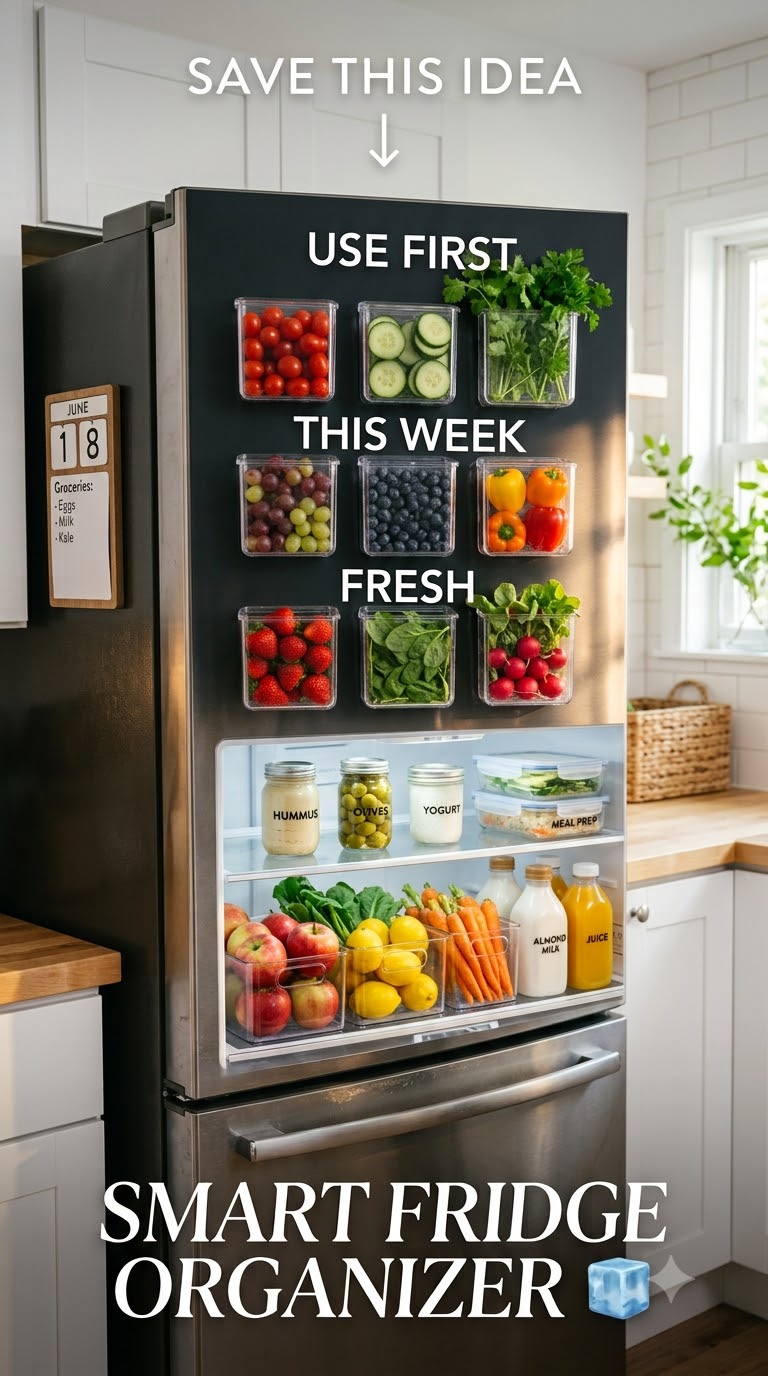


Ever opened the refrigerator and wondered, “When did I put this in here?” 😅
The Fridge Door Freshness Tracker is a simple but clever kitchen organization idea that helps you keep track of when opened foods, leftovers, sauces, dairy products, and other refrigerated items should be used.
Instead of relying on memory, you create a visible tracking system directly on or beside the refrigerator door.
It turns an ordinary fridge into a more organized freshness-control station.
🧊 What Is a Fridge Door Freshness Tracker?
The idea is simple.
Create a small reusable tracking area on your refrigerator door containing information such as:
FOOD → OPENED ON → USE BY
For example:
| Food | Opened | Use First |
|---|---|---|
| Milk | Aug 10 | Aug 13* |
| Pasta Sauce | Aug 9 | Check label |
| Leftovers | Aug 11 | Check food-safety guidance |
| Yogurt | Aug 8 | Check package |
*Storage times vary by food and refrigerator conditions; use the product label and reliable food-safety guidance rather than assuming one universal number.
🏷️ 1. Create Magnetic Freshness Tags
One of the easiest versions uses small reusable magnetic labels.
Each tag can contain:
ITEM: __________
OPENED: __________
USE BY: __________
Attach the tag near the corresponding item or place it on a dedicated fridge tracker.


✨ 2. Use a “USE FIRST” Zone
Create a dedicated section of the fridge for foods that should be used sooner.
A simple label can say:
⚡ USE FIRST
Place recently opened items, leftovers, and foods approaching their labeled use-by date in this area.
This makes them much harder to forget.
🥛 3. Track Opened Products
Some foods are easy to forget once opened.
Examples include:
- Sauces
- Dips
- Jars
- Dairy products
- Pickles
- Condiments
- Ready-to-eat foods
Instead of remembering the opening date, write it down immediately.
🥗 4. Add a Leftover Tracker
Create a small magnetic board on the fridge door.
LEFTOVERS
Food: __________
Made: __________
Use according to food-safety guidance: __________
This is particularly useful after large family meals when several containers enter the refrigerator at once.
🎨 5. Color-Code the Tracker
Color coding makes the system much faster to understand.
🟢 GREEN
Recently stored / comfortably within its planned use period.
🟡 YELLOW
Use soon.
🔴 RED
Check immediately—don’t automatically assume it’s safe just because it looks or smells normal.
Color should be a visual reminder, not a substitute for food-safety guidance.
📅 6. Add a Weekly Freshness Check
Choose one day each week to quickly inspect the refrigerator.
Check:
✓ Opened foods
✓ Leftovers
✓ Package dates
✓ Items that need using soon
✓ Anything showing spoilage
Move foods that need attention toward the front.
🧲 7. Magnetic Fridge Door Calendar
For a more advanced version, combine the tracker with a small monthly calendar.
Use the calendar to record:
MON → leftover added
WED → sauce opened
FRI → meal prep
This creates a simple visual history without requiring an app.


📱 8. Smart Digital Version
If you prefer technology, create a simple spreadsheet or phone note containing:
Food | Date Stored/Open | Package Date | Use-First Reminder
You can then set reminders for foods that need attention.
A digital system works particularly well for people who regularly meal-prep.
🥬 9. Organize by Freshness Priority
Instead of organizing the refrigerator only by food category, organize some areas according to priority.
FRONT
Use soon.
MIDDLE
Regularly used foods.
BACK
Longer-lasting items that are appropriate for that location.
Keep foods stored according to the refrigerator manufacturer’s recommendations and food-safety guidance.
🍓 10. Make It Beautiful
Your tracker doesn’t have to look like a boring checklist.
Try a minimalist design:
FRESHNESS ✦
━━━━━━━━━━━━
🥛 DAIRY
🥗 LEFTOVERS
🍓 PRODUCE
🥫 OPENED
⚡ USE FIRST
Use a clean white magnetic board with small handwritten-style labels.
It can become part of your kitchen décor.
💡 A Clever “Eat Me First” Box
Create one transparent refrigerator container labeled:
🍽️ EAT ME FIRST
Whenever something needs to be prioritized, place it inside.
This combines beautifully with the freshness tracker.
Instead of searching through the entire refrigerator, everyone knows exactly where to look for food that should be used first.
🧊 The Ideal Fridge Door Setup
Imagine opening the refrigerator.
At the top of the door is a clean magnetic board:
✦ FRESHNESS TRACKER ✦
USE FIRST
🥗 Leftover pasta — check date
🥛 Opened milk — check label
🍓 Cut fruit — check storage guidance
Below it is a small calendar.
Beside the door is an EAT ME FIRST container.
Everything is visible.
Nothing gets forgotten simply because it was pushed behind another container.


⚠️ Important Food-Safety Reminder
A freshness tracker is an organization tool, not a test of whether food is safe.
Don’t rely only on appearance, smell, or a handwritten date. Follow the food’s package instructions and appropriate food-safety guidance, and when in doubt, discard questionable food.
Also keep your refrigerator at a safe temperature and avoid leaving perishable foods out for extended periods.
🌟 Why This Hack Is So Useful
A good freshness tracker can help you:
- Reduce forgotten leftovers
- See what needs attention
- Make meal planning easier
- Keep the refrigerator organized
- Reduce unnecessary food waste
- Make kitchen routines easier for the whole family
The best part is that you don’t need an expensive smart refrigerator.
A magnetic board, reusable labels, and a few minutes of organization can create the entire system.
🧊 Final Idea
The Fridge Door Freshness Tracker turns the refrigerator door into a tiny command center.
Instead of opening the fridge and wondering what needs to be eaten first, you can immediately see what you’ve opened, what you’ve stored, and what deserves attention.
A tiny tracker can make your entire refrigerator feel smarter, cleaner, and easier to manage. 🧊✨