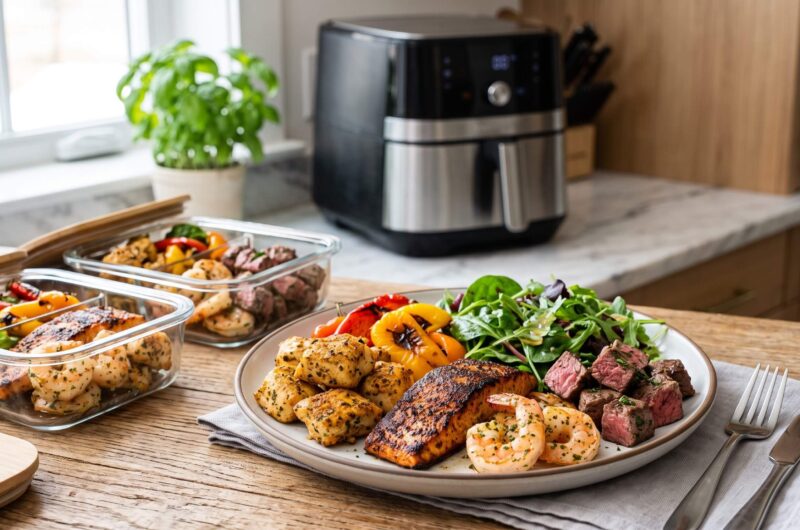

Introduction
Fat loss ultimately comes down to a sustained calorie deficit — but what you eat inside that deficit determines whether you lose fat or lose muscle. This is where protein earns its reputation as the most important macronutrient for body recomposition. Protein has the highest thermic effect of food (TEF) of any macronutrient, meaning your body burns roughly 20–30% of the calories from protein just digesting and metabolizing it, compared to 5–10% for carbohydrates and 0–3% for fat. Practically, this means a 40-gram protein serving costs your body 8–12 calories simply to process — a small but meaningful edge when repeated across every meal, every day, for months.
Protein also blunts hunger more effectively than fat or carbs by increasing satiety hormones like peptide YY and GLP-1, while suppressing ghrelin, the hormone that drives cravings. Combined with resistance training, adequate protein intake (generally 0.7–1g per pound of bodyweight) preserves lean muscle mass during a deficit, which keeps your resting metabolic rate higher than calorie-cutting alone would allow.
This is where the air fryer becomes a genuine ally rather than a kitchen gadget trend. Air fryers work by rapidly circulating superheated air (typically 350°F–400°F) around food in a compact chamber, creating a Maillard-reaction crust on the exterior — similar to pan-searing — while trapping internal moisture through speed of cooking rather than submersion in oil. Lean proteins like chicken breast, white fish, and 93% lean ground beef are notoriously prone to drying out under conventional broiling or grilling because prolonged heat exposure evaporates moisture. Convection cooking shortens that exposure window dramatically, often cutting cook times by 25–30% compared to a conventional oven, while using a fraction (or none) of the oil required for pan-frying. The result: meals that hit both your macro targets and your schedule.
Kitchen Blueprint & Air Fryer Mastery
Not all air fryers behave the same, and understanding your equipment prevents the two most common failure points: undercooked centers and dry exteriors.
Basket-style vs. oven-style air fryers. Basket air fryers use a single high-velocity fan positioned above or behind a perforated basket, producing intense, close-range circulation ideal for smaller cuts like chicken tenders, shrimp, and beef bites — food closer to the heat source cooks faster and crisps more aggressively. Oven-style air fryers (including air fryer toaster ovens) distribute air across a larger multi-rack chamber, better suited for batch-cooking multiple proteins simultaneously, though they typically run 15–20°F cooler at the same dial setting due to the larger internal volume. If you’re using an oven-style unit, add roughly 2 minutes to basket-style recipe times below and check for doneness early.
Internal circulation dynamics. Overcrowding the basket is the single biggest cause of unevenly cooked, soggy-instead-of-crisp results. Superheated air needs unobstructed pathways around each piece of food; stacking or overlapping proteins blocks that circulation and traps steam. Cook in a single layer with visible gaps, and shake or flip halfway through the cycle.
Oil delivery matters more than oil quantity. Aerosol cooking sprays (the canned propellant type) contain lecithin and other emulsifiers that break down non-stick coatings over repeated high-heat exposure, leading to flaking and reduced basket lifespan. A refillable oil mister or pump sprayer loaded with olive or avocado oil delivers the same light, even coating — enough for browning and spice adhesion — without the coating damage or the added propellant chemicals.
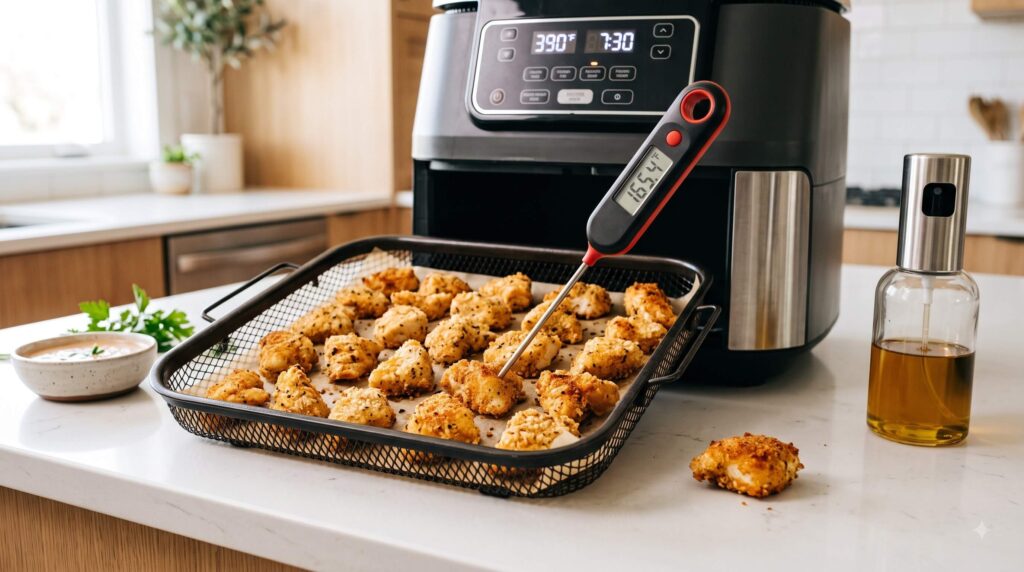
Food thermometers are non-negotiable. Air fryer cook times vary by 1–3 minutes across brands, wattages, and even how recently the unit was preheated. An instant-read digital thermometer is the only reliable way to confirm doneness without overcooking lean proteins into rubber. Insert it into the thickest part of the cut, avoiding bone or the basket floor.
The 20 Rapid Meal Formulations
All recipes serve 1 and stay under 450 calories with 35–50g protein. Preheat your air fryer for 3 minutes before adding food unless noted.
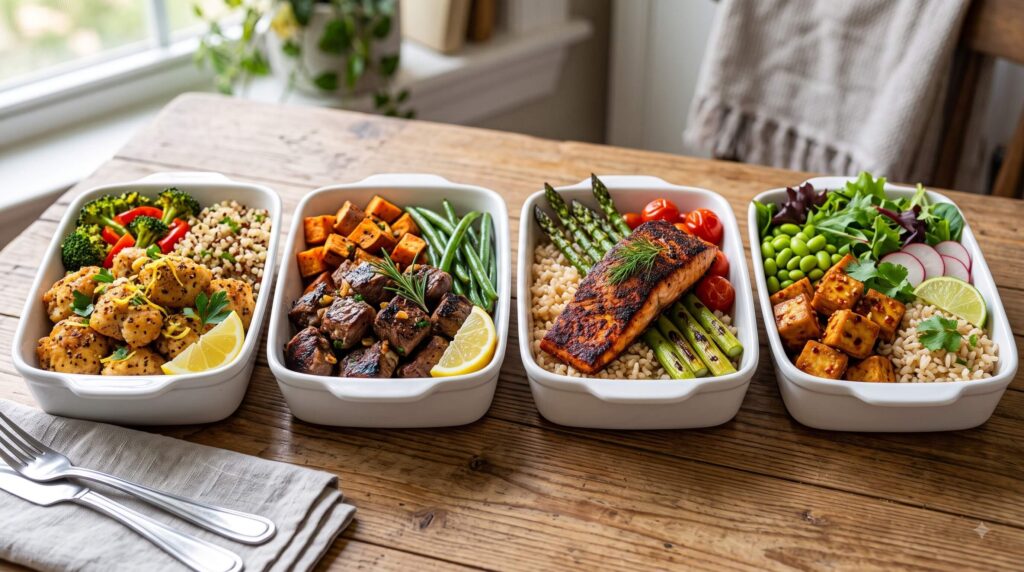
Poultry
1. Lemon-Pepper Chicken Breast Bites Macros: 380 cal | 48g protein | 4g net carbs | 14g fat Cube 6oz chicken breast, toss with 1 tsp olive oil, lemon zest, cracked pepper, and garlic powder. Air fry at 400°F for 10–12 minutes, shaking at the halfway mark. Pro secret: cube uniformly (1-inch pieces) so nothing overcooks before the rest finishes.
2. Smoky Paprika Chicken Thighs Macros: 410 cal | 40g protein | 2g net carbs | 22g fat Pat 6oz boneless, skinless thighs dry, rub with smoked paprika, cumin, and salt. Air fry at 380°F for 12 minutes, flipping once. Thighs’ higher fat content makes them nearly impossible to dry out — ideal for beginners.
3. Buffalo Chicken Tenders Macros: 350 cal | 45g protein | 3g net carbs | 12g fat Toss 6oz chicken tenders in 1 tbsp buffalo hot sauce and light avocado oil mist. Air fry at 400°F for 9–10 minutes. Prep hack: buy pre-cut tenders to skip the slicing step entirely.
4. Greek Yogurt-Marinated Chicken Skewers Macros: 365 cal | 46g protein | 5g net carbs | 11g fat Marinate cubed chicken in plain Greek yogurt, oregano, and lemon for 10 minutes (or overnight for meal prep), thread onto skewers. Air fry at 390°F for 11 minutes. The yogurt’s acidity tenderizes the meat and prevents surface drying.
5. Turkey & Spinach Meatballs Macros: 320 cal | 38g protein | 4g net carbs | 13g fat Mix 6oz ground turkey (93% lean) with chopped spinach, egg white, and Italian seasoning. Form 6 balls. Air fry at 375°F for 10 minutes. Pro secret: wet your hands before rolling to prevent sticking without added fat.