
Comprehensive Ingredient Breakdown & Smart Swaps
Here’s every ingredient, why it’s there, and how to swap it for your household’s needs.
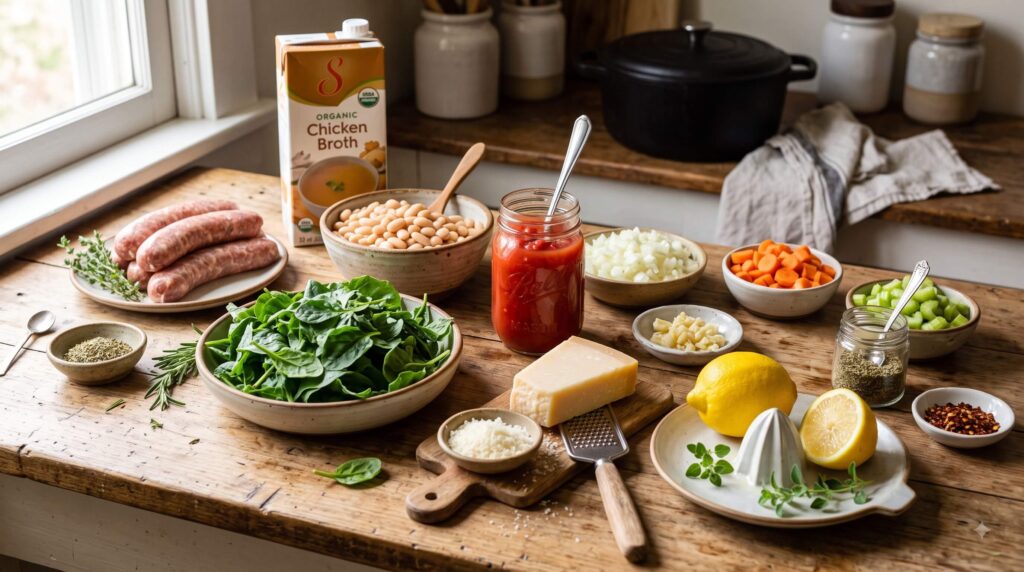
Italian chicken sausage (1 lb, casings removed) — This is your protein and your fat-flavor base. Chicken sausage keeps it leaner than pork while still delivering big flavor from fennel and garlic seasoning. Swaps: Turkey sausage works identically. For a budget move, Costco’s rotisserie-seasoned ground chicken or Trader Joe’s Hot Italian Chicken Sausage are both excellent and reliably in stock. Vegetarian? Swap in a plant-based Italian sausage (Beyond or TJ’s brand) and add it in the last 30 minutes so it doesn’t overcook.
Yellow onion, diced (1 medium) — The aromatic backbone; sweetens as it cooks. Swap: Shallots for a milder, slightly sweeter flavor.
Garlic, minced (4 cloves) — Adds pungency that mellows into deep savoriness over the long cook. Swap: Pre-minced jarred garlic (1.5 tsp per clove) works fine here — no shame in the shortcut.
Carrots, diced (2 medium) — Adds natural sweetness and body, plus fiber and beta-carotene.
Celery, diced (2 stalks) — The classic aromatic trio partner; adds a subtle herbal note that rounds out the onion and carrot.
Cannellini (white kidney) beans, 2 cans, divided — Your protein-and-fiber powerhouse and, when partially blended, your natural thickener. Swap: Great Northern or navy beans work interchangeably. Dried beans (soaked overnight) work too — just add 1 cup dry, pre-soaked, and increase liquid by 1 cup.
Diced tomatoes, 1 can (14.5 oz) — Adds acidity, color, and a subtle sweetness that balances the richness of the sausage. Swap: Fire-roasted diced tomatoes add a smoky depth if you want to level it up.
Low-sodium chicken broth (4 cups) — Your liquid base. Low-sodium is specified deliberately — canned beans and sausage already carry salt, so starting low lets you control the final seasoning rather than fighting an over-salted pot. Swap: Vegetable broth for a lighter, veg-forward version. Bouillon cubes/paste (like Better Than Bouillon) are a budget-friendly, low-sodium-adjustable option many home cooks keep on hand.
Baby kale or spinach (3 cups, packed) — Stirred in at the very end for color, nutrients, and a fresh contrast to the rich broth. Swap: Frozen spinach (thawed and drained) works in a pinch and is often cheaper per ounce at Costco.
Parmesan rind or grated Parmesan (optional but recommended) — A rind simmered in the broth adds a deep umami, nutty backbone that’s genuinely hard to replicate. Grated Parmesan stirred in at the end works too. Swap: Nutritional yeast (2 tbsp) for a dairy-free umami boost.
Heavy cream or half-and-half (1/2 cup, optional) — For an even silkier finish, stirred in at the very end. Swap: Dairy-free: full-fat coconut milk (unsweetened) or a cashew cream. Lower-calorie: whole milk plus 1 tsp cornstarch, or skip entirely — the blended beans already provide plenty of creaminess.
Italian seasoning, red pepper flakes, salt & pepper — Your seasoning layer, adjustable to taste. Red pepper flakes are optional but add a gentle background warmth that makes the soup feel more complex.
Lemon juice (1–2 tbsp, added at the end) — The acidity “unlock” discussed above. Don’t skip this — it’s the difference between good and “can I have the recipe.”
Gluten-free note: This recipe is naturally gluten-free as written — just double-check your sausage’s ingredient label, since some brands use bread fillers. Low-sodium note: Use no-salt-added beans and tomatoes plus low-sodium broth, and season with black pepper, extra garlic, and a bigger pour of lemon at the end to keep flavor high without the sodium. Budget tip: Trader Joe’s carries some of the best price-per-ounce Italian chicken sausage and canned cannellini beans in the country; Costco’s rotisserie chickens and bulk broth are unbeatable if you’re feeding a crowd on repeat.