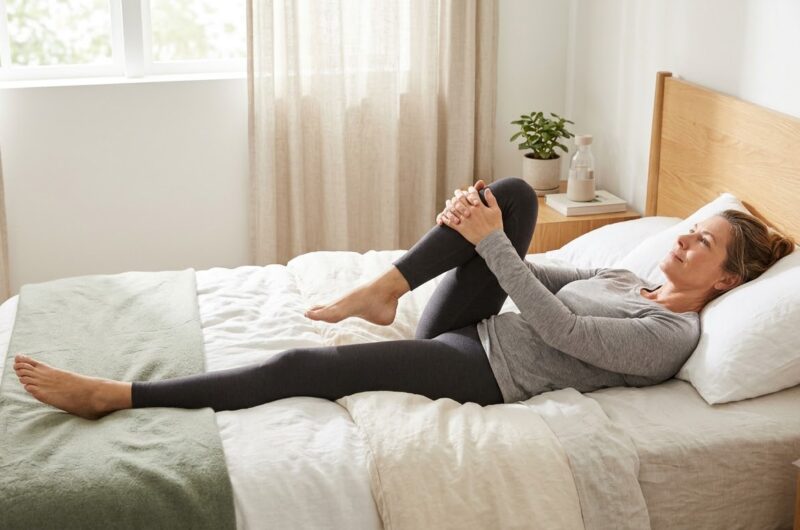

Waking up with lower back pain or a sharp, uncomfortable sensation traveling down your leg can make even the simplest morning activities feel difficult. Whether you spend long hours sitting at a desk, have trouble getting comfortable at night, or experience occasional sciatic nerve discomfort, gentle movement may help you feel more comfortable.
The good news is that you do not always need an expensive gym membership or complicated exercise equipment to start moving. A few gentle stretches performed on your bed can help loosen stiff muscles, improve comfortable movement, and make it easier to begin your day.
These 5-minute bed stretches for sciatica and lower back pain are designed as a simple, beginner-friendly movement routine. They can be performed while lying on your back, making them a convenient option for people who prefer gentle exercises without getting down onto the floor.
However, stretching is not a cure for sciatica, and the right exercises depend on the cause of your symptoms. The goal is to move comfortably without forcing your body into painful positions.
In this guide, you will discover five gentle bed stretches, how to perform each one correctly, common mistakes to avoid, and additional tips for supporting your lower back throughout the day.
What Is Sciatica and How Does It Affect Your Lower Back?
Sciatica refers to pain caused by irritation or compression of the sciatic nerve or its nerve roots. The sciatic nerve begins in the lower back, travels through the buttocks, and extends down the back of each leg toward the feet.
When this nerve becomes irritated, discomfort may travel along its pathway.
Unlike ordinary lower back muscle soreness, sciatica often causes symptoms that extend beyond the lower back.
Common symptoms include:
- Sharp, shooting, or burning pain in the buttocks or leg.
- Tingling or pins-and-needles sensations.
- Numbness in part of the leg or foot.
- Discomfort that becomes worse after prolonged sitting.
- Pain that travels from the lower back toward the calf or foot.
- Weakness in the affected leg or foot.
Sciatica usually affects one side of the body, although symptoms can vary.
Lower back pain, on the other hand, can develop for several reasons, including muscle strain, prolonged sitting, poor lifting technique, or changes involving the spinal joints and discs.
It is important to understand that not every case of lower back pain is sciatica. Identifying the underlying cause can help determine which movements are appropriate.
Can 5-Minute Bed Stretches Help Relieve Sciatica and Lower Back Pain?
Gentle stretching and movement may help some people manage lower back discomfort and improve mobility.
When your back feels stiff after sleeping or sitting for several hours, slow movements can help you gradually return to comfortable activity.
A short bed-based routine may offer several potential benefits:
1. Helps Reduce Muscle Stiffness
Gentle movement can help loosen tight muscles around the hips, buttocks, and lower back. This may make everyday activities, such as standing up or walking, feel more comfortable.
2. Encourages Comfortable Mobility
Moving your hips and knees through a comfortable range of motion can help maintain flexibility and reduce the feeling of stiffness.
3. Provides a Gentle Morning Movement Routine
Some people find it easier to begin moving while lying down rather than immediately standing or bending forward.
4. Helps You Become More Aware of Your Body
Slow, controlled movements encourage you to notice which positions feel comfortable and which ones increase discomfort.
5. Creates a Consistent Self-Care Habit
A five-minute routine is short enough to fit into a morning or evening schedule. Consistency with appropriate movement can support a broader recovery plan.
Remember that these benefits are not guaranteed. A stretch that feels helpful for one person may aggravate symptoms in another. Exercise should always be adjusted to your condition and comfort level.
5-Minute Bed Stretch Routine for Sciatica and Lower Back Pain
This simple routine includes five gentle movements that can be performed on a supportive mattress.
You do not need special equipment. A comfortable bed and a small pillow are usually enough.
Before starting:
- Lie on your back in a comfortable position.
- Keep your movements slow and controlled.
- Breathe normally throughout each stretch.
- Avoid bouncing, pulling, or forcing your knees.
- Stop if pain, tingling, numbness, or weakness increases.
The suggested timings below are approximate. You can shorten or skip any movement that does not feel comfortable.
1. Gentle Pelvic Tilts (1 Minute)
Pelvic tilts are a simple movement that helps you gently engage your abdominal muscles and move your lower back.
They can be a useful starting exercise for people who feel stiff after sleeping.
How to do it:
- Lie flat on your back with your knees bent.
- Place your feet comfortably on the bed, approximately hip-width apart.
- Relax your shoulders and keep your arms beside your body.
- Gently tighten your abdominal muscles.
- Slowly tilt your pelvis so your lower back moves slightly toward the mattress.
- Hold the position for approximately three to five seconds.
- Relax and return to your natural starting position.
- Repeat slowly for about one minute.
Why it may help:
Pelvic tilts encourage gentle movement in the lower back while activating the abdominal muscles. They also help you practice controlling your pelvic position without making large movements.
Helpful tip: Keep the movement small. You do not need to press your back forcefully into the mattress.
2. Single Knee-to-Chest Stretch (1 Minute)
The single knee-to-chest stretch gently moves the hip and lower back through a comfortable range of motion.
Some people find this position relaxing when their lower back feels tight. However, it is not appropriate for every type of sciatica.
How to do it:
- Lie on your back with both knees bent.
- Keep one foot resting comfortably on the mattress.
- Slowly bring the opposite knee toward your chest.
- Place your hands behind your thigh or around your shin, wherever feels comfortable.
- Gently guide your knee closer without forcing it.
- Hold for approximately five to ten seconds if comfortable.
- Slowly return your foot to the starting position.
- Repeat with the opposite leg.
Continue alternating gently for approximately one minute.
Why it may help:
This movement gently stretches the hip and surrounding lower-back muscles. It may improve comfortable hip movement and reduce feelings of stiffness.
Helpful tip: Do not pull your knee tightly toward your chest. If the movement causes shooting pain or increases symptoms down your leg, stop.
3. Supine Knee Rolls (1 Minute)
Supine knee rolls are a gentle mobility exercise that allows your lower back and hips to move from side to side.
They are sometimes called lying trunk rotations.
How to do it:
- Lie on your back with both knees bent.
- Place your feet comfortably on the mattress.
- Keep your shoulders relaxed.
- Slowly allow both knees to move a small distance toward one side.
- Keep your upper body relaxed and avoid forcing the movement.
- Return your knees to the center.
- Gently repeat on the opposite side.
Continue moving from side to side for approximately one minute, staying within a comfortable range.
Why it may help:
This movement encourages gentle mobility around the hips and lower back. It can be useful for people who experience stiffness after remaining in one position for a long time.
Helpful tip: Your knees do not need to touch the mattress. Even a small, comfortable movement is enough.
4. Supported Hamstring Stretch (1 Minute)
The hamstrings are the muscles located along the back of your thighs. Tightness in this area may contribute to a feeling of restricted movement.
A gentle supported hamstring stretch can help maintain comfortable flexibility.
However, people with sciatica should be particularly careful. Stretching the back of the thigh too aggressively can increase tension on an already sensitive nerve.
How to do it:
- Lie on your back with both knees bent.
- Slowly raise one thigh toward your body.
- Support the back of your thigh with both hands.
- If comfortable, gradually straighten your knee until you feel a mild stretch in the back of your thigh.
- Keep your ankle relaxed rather than pulling your toes aggressively toward your body.
- Hold briefly for five to ten seconds.
- Slowly bend your knee and return your foot to the mattress.
- Repeat with the opposite leg.
Spend approximately 30 seconds on each side, adjusting the movement to your comfort.
Why it may help:
A gentle hamstring stretch may help maintain flexibility in the back of your thighs and support comfortable hip movement.
Helpful tip: You should feel a mild muscular stretch, not burning, electric, shooting, or increasing pain. If you experience nerve-related symptoms, skip this exercise.
5. Gentle Figure-Four Hip Stretch (1 Minute)
The figure-four stretch gently targets the muscles around the hip and buttocks.
Some people experience tightness in these areas alongside lower back discomfort. This movement may help improve hip flexibility when performed comfortably.
How to do it:
- Lie on your back with both knees bent.
- Keep both feet resting on the mattress.
- Slowly place your right ankle over your left thigh, just above the knee.
- Keep your right foot relaxed and avoid pushing your knee downward.
- If comfortable, remain in this position for approximately 15 seconds.
- Return your right foot to the mattress.
- Repeat on the opposite side.
Spend approximately 30 seconds on each side, including the transition.
Why it may help:
The figure-four position gently stretches muscles around the hips and buttocks. It may be useful when hip stiffness accompanies lower back discomfort.
Helpful tip: Do not force your knee toward the mattress or pull your supporting leg toward your chest. If the position causes symptoms to travel farther down your leg, stop.
Your Complete 5-Minute Bed Stretch Schedule
Here is a quick overview of the routine so you can follow it without remembering every instruction.
| Exercise | Suggested time | Main focus |
|---|---|---|
| Gentle pelvic tilts | 1 minute | Lower-back mobility |
| Single knee-to-chest | 1 minute | Hip and back movement |
| Supine knee rolls | 1 minute | Gentle trunk mobility |
| Supported hamstring stretch | 1 minute | Back-of-thigh flexibility |
| Figure-four hip stretch | 1 minute | Hip and buttock flexibility |
| Total | 5 minutes | Gentle movement |
You do not need to complete all five stretches every day. Choose movements that feel comfortable and appropriate for your symptoms.
If you are unsure which exercises are suitable, consult a physical therapist or healthcare professional before beginning.
How to Perform Bed Stretches Safely
Stretching should feel controlled and comfortable, not like a competition to see how far you can move.
When dealing with lower back pain or sciatica, a few simple precautions can make your routine safer.
Move slowly. Avoid sudden movements, jerking, or bouncing. Give your muscles and joints time to adjust.
Do not force a stretch. A mild stretching sensation may be acceptable, but sharp pain or increasing nerve symptoms are not.
Breathe naturally. Avoid holding your breath. Slow breathing can help you stay relaxed while moving.
Use support when needed. A small pillow under your head or beneath your knees may make lying positions more comfortable.
Pay attention to leg symptoms. If discomfort starts traveling farther down your leg, or numbness and tingling increase, stop that movement.
Avoid comparing your flexibility with others. Your comfortable range of motion may be different from someone else’s.
Most importantly, do not use stretching to push through significant pain. A healthcare professional can help you identify movements that match your symptoms.
What Causes Lower Back Pain and Sciatica to Become Worse?
Lower back discomfort and sciatic nerve symptoms can have several underlying causes.
Understanding common triggers can help you make better decisions about daily movement and recovery.
1. Sitting for Long Periods
Remaining seated for extended periods may increase discomfort in some people, especially when they rarely change positions.
Taking short movement breaks can help reduce prolonged inactivity.
2. Poor Lifting Technique
Repeatedly bending, twisting, or lifting heavy objects without appropriate control can strain the muscles and other structures around your lower back.
Try to keep objects close to your body and avoid twisting while lifting.
3. Muscle Strain
Sudden movements, unfamiliar exercise, or lifting something heavier than usual can strain the muscles supporting your lower back.
This can result in stiffness, soreness, and difficulty moving comfortably.
4. Disc-Related Problems
A bulging or herniated disc may irritate nearby nerve roots and contribute to sciatica.
This is one of the common causes of sciatic nerve pain.
5. Limited Physical Activity
A lack of regular movement can contribute to reduced strength, flexibility, and physical conditioning.
Gradually returning to appropriate activities may help improve overall movement tolerance.
Not every case of back pain has an obvious trigger. Persistent or worsening symptoms deserve professional assessment rather than repeated attempts to stretch the discomfort away.
Additional Daily Habits That May Support Lower Back Comfort
Your five-minute bed routine is only one part of taking care of your back.
Small adjustments throughout the day may also help you manage stiffness and maintain comfortable movement.
Take Regular Walking Breaks
Walking is a simple way to remain active.
If you spend most of your day sitting, try taking short walks throughout the day rather than remaining in one position for hours.
Start with a comfortable distance and gradually increase your activity.
Avoid Staying in Bed All Day
Although resting may feel appealing when your back hurts, prolonged bed rest is generally not recommended for ordinary lower back pain or uncomplicated sciatica.
Gentle daily activity, adjusted to your symptoms, is usually a better approach.
Choose a Comfortable Sleeping Position
There is no single sleeping position that works for everyone.
You may find these options comfortable:
- Side sleeping: Place a small pillow between your knees to support a comfortable hip position.
- Back sleeping: Try placing a pillow beneath your knees if it reduces pressure or discomfort.
- Changing positions: Avoid remaining in one position if it makes your symptoms worse.
The best position is the one that allows you to rest comfortably without increasing your symptoms.
Pay Attention to Your Sitting Position
If you work at a desk, use a chair that supports your lower back.
Keep your feet supported, avoid remaining in one position for too long, and adjust your workstation to reduce unnecessary reaching or bending.
Build Strength Gradually
Stretching alone is not a complete long-term solution for back health.
Depending on your condition, a physical therapist may recommend exercises that strengthen your abdominal, hip, and back muscles.
A gradual exercise program can help improve overall physical conditioning and support your daily activities.
When Should You Avoid Sciatica and Lower Back Stretches?
Not every type of back pain should be treated with home stretching.
Avoid starting this routine without medical guidance if you have recently experienced a significant back injury, undergone surgery, or developed unexplained or rapidly worsening symptoms.
You should also seek professional advice if you have:
- Severe or worsening lower back pain.
- New or increasing numbness or weakness in a leg.
- Pain that repeatedly interferes with sleeping or daily activities.
- Fever or feeling generally unwell alongside back pain.
- Unexplained weight loss.
- Back pain following a significant fall or accident.
Important emergency warning:
Seek emergency medical attention immediately if you experience any of the following:
- New numbness around your genitals, inner thighs, or the area around your anus.
- Difficulty starting urination, inability to urinate, or loss of bladder control.
- Loss of bowel control or inability to sense when you need to have a bowel movement.
- Severe or worsening weakness or numbness in both legs.
These symptoms may indicate a serious condition called cauda equina syndrome or another urgent spinal problem.
Do not attempt to treat these warning signs with stretching.
Frequently Asked Questions About Sciatica and Lower Back Pain Bed Stretches
1. Can I do sciatica stretches while lying in bed?
Yes, some gentle mobility exercises can be performed while lying on your back. Examples include pelvic tilts, comfortable knee movements, and selected hip stretches.
However, not every exercise is appropriate for every person with sciatica. Choose movements that do not increase your symptoms and seek professional guidance if you are unsure.
2. What is the best 5-minute stretch for lower back pain?
There is no single best stretch for everyone.
Gentle pelvic tilts and comfortable knee rolls may be useful starting movements for some people experiencing lower back stiffness.
The most appropriate exercise depends on the underlying cause of your pain, your mobility, and how your body responds.
3. Should I stretch in the morning or before bed?
You can try gentle movements in the morning or evening, depending on when they feel most comfortable.
Morning movements may help you ease into daily activities, while a relaxing evening routine may help you move comfortably before sleeping.
Avoid any exercise that increases pain or nerve symptoms.
4. How often should I do these bed stretches?
You can use a short routine as a starting point if the exercises are appropriate for your condition.
However, more stretching is not necessarily better. Start gently, monitor your symptoms, and follow an individualized exercise plan if you have ongoing sciatica.
5. Can bed stretches cure sciatica?
No. Bed stretches cannot guarantee a cure for sciatica.
Sciatica can develop for different reasons, including disc-related problems and irritation of nerve roots. Many people improve with time, activity modification, and appropriate treatment, but some need physical therapy or additional medical care.
6. Is walking good for sciatica?
For many people, gentle walking can help maintain activity and mobility.
Start with short, comfortable walks and gradually increase the duration if your symptoms allow. If walking significantly worsens your pain or causes increasing weakness or numbness, seek medical advice.
7. Why does my lower back hurt more in the morning?
Morning stiffness can occur for several reasons, including remaining in one position during sleep, muscle stiffness, and underlying spinal or joint conditions.
If your morning pain is persistent, severe, or accompanied by other concerning symptoms, arrange a medical assessment.
8. Should I use a pillow under my knees when sleeping?
Some people find that placing a pillow under their knees while sleeping on their back helps them feel more comfortable.
Side sleepers may prefer a pillow between their knees. These are comfort adjustments, not treatments for the underlying cause of sciatica.
9. Can tight hamstrings cause sciatica?
Tight hamstrings and sciatica are not the same condition.
Hamstring tightness can contribute to discomfort or restricted movement, while sciatica involves irritation of nerve roots or the sciatic nerve.
Aggressive hamstring stretching may aggravate nerve-related symptoms, so gentle movements and individualized guidance are important.
10. When should I see a doctor for lower back pain?
Seek medical advice if your pain is severe, getting worse, affecting everyday activities, or not improving after a few weeks of self-care.
Seek emergency care for bladder or bowel changes, numbness around the groin or anus, or severe or progressive weakness affecting both legs.
Final Thoughts: Make Five Minutes for Gentle Back Movement
Living with lower back discomfort or sciatica can make mornings, bedtime, and everyday activities more challenging. However, gentle movement may be a helpful part of managing symptoms when the exercises are appropriate for your condition.
These five-minute bed stretches offer a simple way to explore comfortable movement without special equipment. From gentle pelvic tilts to supported hip stretches, each exercise focuses on moving slowly and respecting your body’s limits.
Remember that consistency does not mean pushing through pain. Some movements may feel helpful, while others may not suit your particular symptoms.
Combine appropriate stretching with regular walking, comfortable sleeping positions, movement breaks, and professional guidance when needed.
Most importantly, listen to your body. If pain increases, stop the movement. If symptoms persist or become worse, speak with a healthcare professional about a treatment plan that addresses the underlying cause.
A few gentle minutes can be a useful starting point, but safe movement and the right treatment matter more than completing every stretch.
Medical Disclaimer: This article is for educational purposes only and is not a substitute for professional medical advice, diagnosis, or treatment. Sciatica and lower back pain can have different causes. Consult a qualified healthcare professional before starting a new exercise routine, particularly if you have existing symptoms, an injury, or a diagnosed spinal condition.