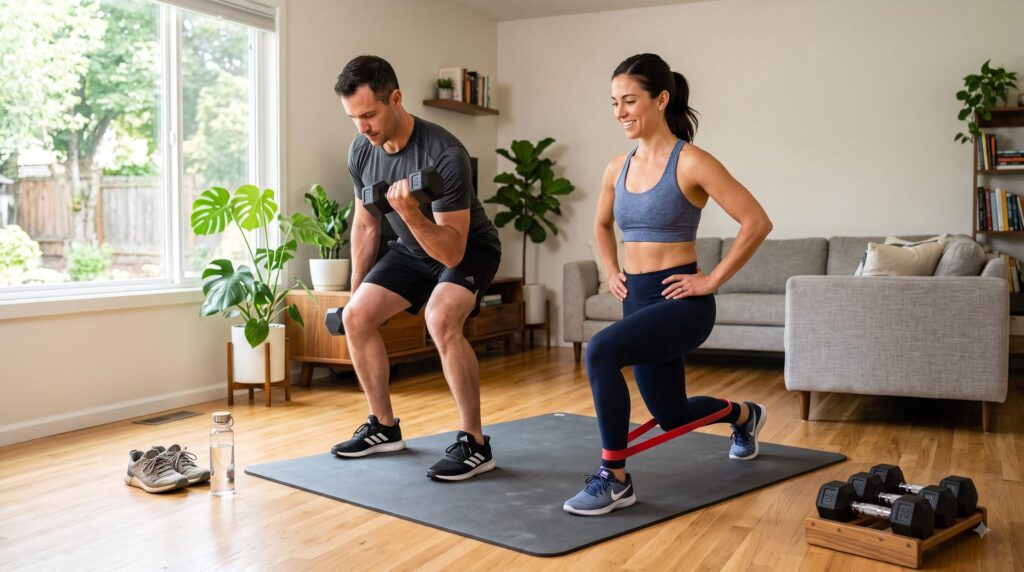

Dual-Gender Workout Blueprint
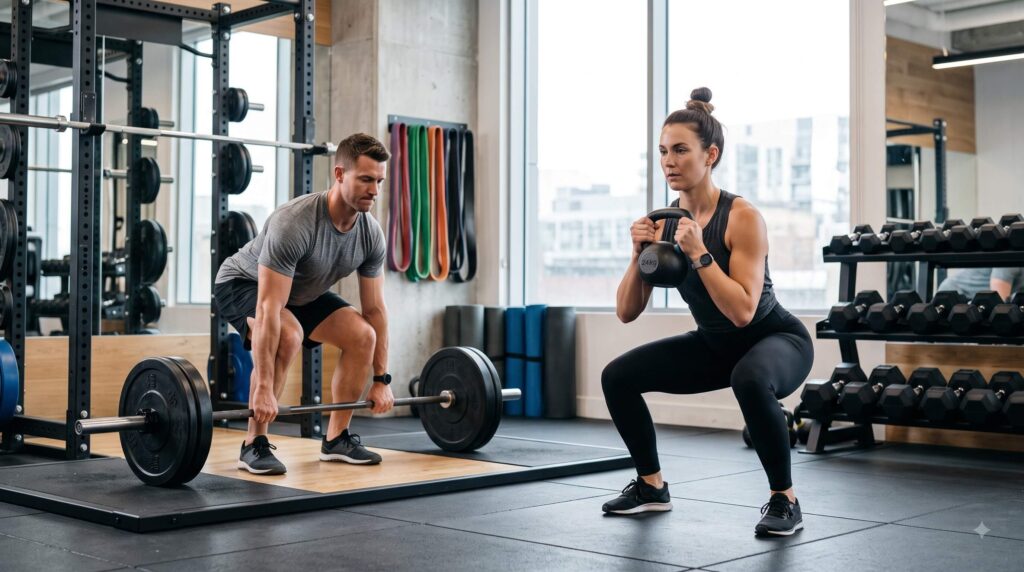
Weekly Split (Both Genders)
- 4 Days: Resistance Training
- 2 Days: Active Recovery (walking, yoga, mobility)
- 1 Day: Full Rest
For Men — Strength Focus & Progressive Overload
Focus on compound lifts, adding weight or reps weekly.
- Day 1 — Lower Body Push: Squats, leg press, walking lunges, calf raises
- Day 2 — Upper Push: Bench press, overhead press, dips, triceps pushdowns
- Day 3 — Active Recovery: 45-min incline walk or yoga flow
- Day 4 — Lower Body Pull: Deadlifts, Romanian deadlifts, hamstring curls, hip thrusts
- Day 5 — Upper Pull: Pull-ups, rows, bicep curls, rear delt flyes
- Day 6 — Active Recovery: Sports/swimming/light cycling
- Day 7 — Full Rest
Progressive overload rule: Add either 5 lbs or 1–2 reps to your main lift every week. If you can’t, your recovery (sleep/food) needs attention before your training does.
For Women — Toning, Core Stability & Cardio-Respiratory Targets
Focus on full-body strength with a core-stability and metabolic-conditioning emphasis.
- Day 1 — Full Body Strength A: Goblet squats, dumbbell rows, glute bridges, plank holds
- Day 2 — Cardio-Respiratory + Core: 25-min incline treadmill intervals + dead bugs, bicycle crunches, side planks
- Day 3 — Active Recovery: 45-min walk or restorative yoga
- Day 4 — Full Body Strength B: Romanian deadlifts, step-ups, shoulder press, bird dogs
- Day 5 — Lower Body & Glute Focus: Hip thrusts, lateral band walks, split squats, calf raises
- Day 6 — Active Recovery: Pilates or light cycling
- Day 7 — Full Rest
Cardio-respiratory target: Build to sustaining 20–25 minutes at 65–75% max heart rate (roughly: 220 minus your age, then take 65–75% of that number).
Progressive Daily Step Count
| Week | Daily Step Target |
|---|---|
| Week 1 | 8,000 steps |
| Week 2 | 8,500–9,000 steps |
| Week 3 | 9,500 steps |
| Week 4 | 10,000+ steps |
“What Happens Next?” — Phase 2 & Progression Rules
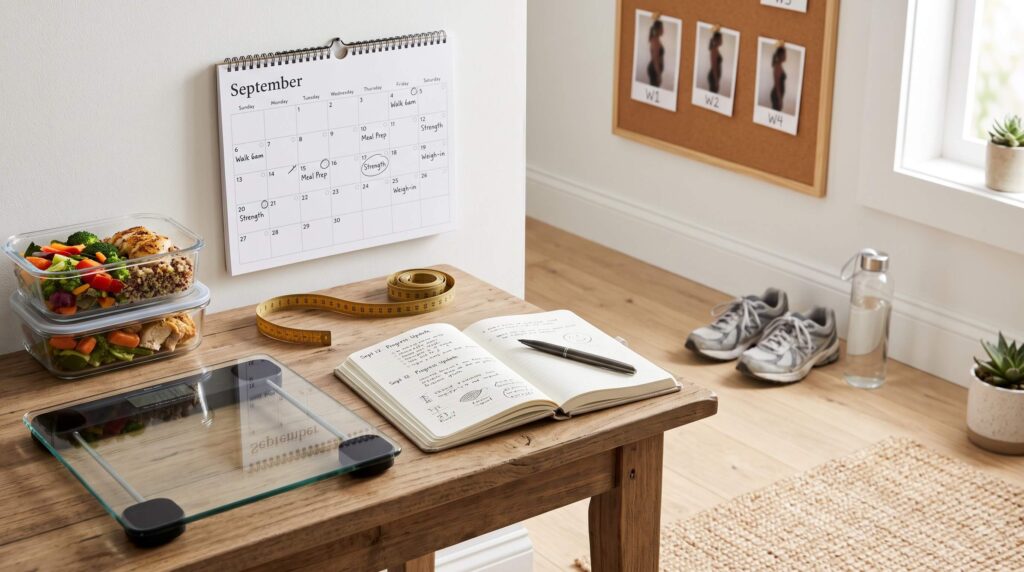
14-Day Check-In
Assess these three markers, not just the scale:
- Weight trend: Average your weigh-ins across the week — expect 1–2 lbs of loss per week as healthy pacing.
- Waist measurement: Should show visible reduction even if the scale is slow.
- Energy & sleep quality: Should be improving, not declining.
30-Day Check-In
- Compare Week 1 vs. Week 4 photos, measurements, and average weight.
- Healthy total range: 4–8 lbs of fat loss for most people, more for higher starting body weight.
If Weight Stalls (No Change for 10–14 Days)
Work through this checklist in order:
- Re-verify your tracking accuracy — are you weighing/measuring food, or eyeballing it?
- Recalculate calories based on your new (lower) bodyweight.
- Increase daily steps by 1,000–1,500 before cutting more calories.
- Add one resistance training set per major muscle group per session.
- Audit sleep and stress — cortisol dysregulation can mask fat loss on the scale.
Transitioning to Long-Term Maintenance
Once you complete the 30 days:
- Increase calories gradually — add 100–150 calories per week until the scale stabilizes. This is called a “reverse diet” and prevents rebound weight gain.
- Keep protein intake and step count as permanent habits — these are the two highest-leverage, lowest-cost behaviors for weight maintenance.
- Shift from “challenge mode” to “80/20 living”: 80% of meals follow your structured plan, 20% has flexibility for social eating.
- Re-test your metabolism data every 8–12 weeks and adjust calories as your bodyweight and activity change.