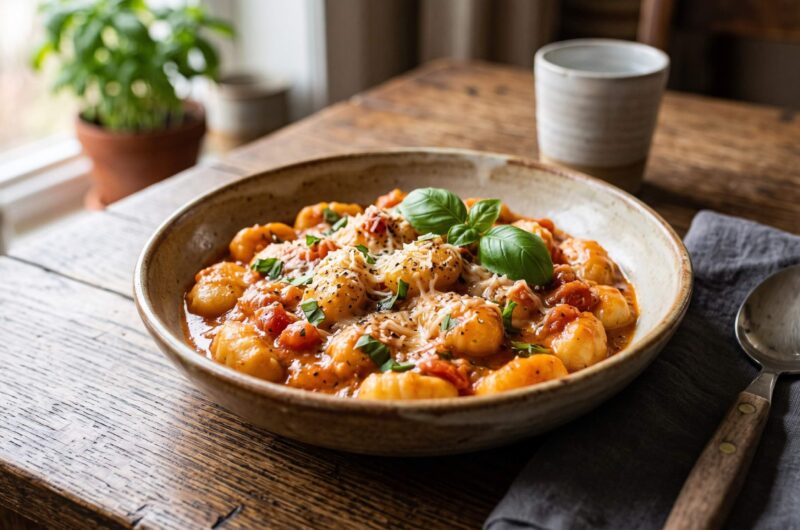

There’s a specific kind of dinner-time panic that hits at 6:15 on a Tuesday: nothing thawed, everyone’s hungry, and the idea of washing three pots afterward feels like its own kind of punishment. This recipe was built for that exact moment. One pot, fifteen minutes, and a sauce that turns thick and velvety without a single spoonful of cornstarch or a splash of heavy cream simmered for an hour. The trick isn’t a secret ingredient — it’s understanding what gnocchi actually does when it cooks directly in liquid instead of a separate pot of boiling water.
Below, I’ll walk through exactly why this method works, not just how to follow it, because knowing the mechanics means you can fix it when something looks off, swap ingredients with confidence, and never end up with a gluey, stuck-together mess again.
Why This Recipe Works
- One pot, minimal starch runoff. Gnocchi releases starch as it cooks. Boiled separately, that starch disappears down the drain. Cooked directly in the sauce, it stays put and does the thickening for you.
- 15 minutes, start to finish. No pasta water to boil separately, no sauce simmering in a second pan. Everything happens in sequence in one vessel.
- Built-in dietary flexibility. Whether you need gluten-free or dairy-free, the base method doesn’t change — only the gnocchi and the cream do.
- Genuinely fast cleanup. One pot, one cutting board, one spoon. That’s the whole list.
Ingredients (Serves 4)
- 1 tablespoon olive oil
- 3 cloves garlic, minced
- 1 small yellow onion, finely diced
- 1 can (28 oz) crushed tomatoes
- 1½ cups vegetable or chicken broth
- 1 lb potato gnocchi (shelf-stable or refrigerated — see notes below)
- ½ teaspoon dried oregano
- ½ teaspoon crushed red pepper flakes (optional)
- ½ cup heavy cream (or cashew cream — see substitution notes)
- ½ cup grated Parmesan, plus more for serving
- ¼ cup fresh basil leaves, torn, plus extra for garnish
- Salt and black pepper, to taste
Shelf-Stable vs. Refrigerated Gnocchi: Why the Difference Matters
Not all gnocchi behaves the same way in a one-pot sauce, and this is the single biggest variable that determines whether your dish comes out silky or gluey.
Shelf-stable gnocchi (the vacuum-sealed kind found in the pasta aisle, not refrigerated) has a lower moisture content and a denser, more compact starch structure. It’s been partially dried during processing, which means it needs slightly more liquid and a minute or two of extra simmer time to fully hydrate. It also holds its shape a bit more stubbornly, which is actually an advantage here — less risk of it disintegrating into mush if you’re multitasking and it simmers a touch too long.
Refrigerated gnocchi (usually found near fresh pasta) is higher in moisture and softer straight out of the package. It cooks faster — often in under 3 minutes — and releases starch more quickly and more aggressively. This is great for a thick sauce in record time, but it also means it’s more prone to overcooking into a sticky, pasty texture if left in simmering liquid too long.
Practical takeaway: if you’re using shelf-stable gnocchi, plan on the full 8–10 minutes of simmering listed below. If you’re using refrigerated gnocchi, start checking for doneness at the 4-minute mark and pull the pot off heat as soon as the gnocchi float and turn tender — carryover heat will finish the job.
The Science of the Sauce: How Starch Replaces Cornstarch
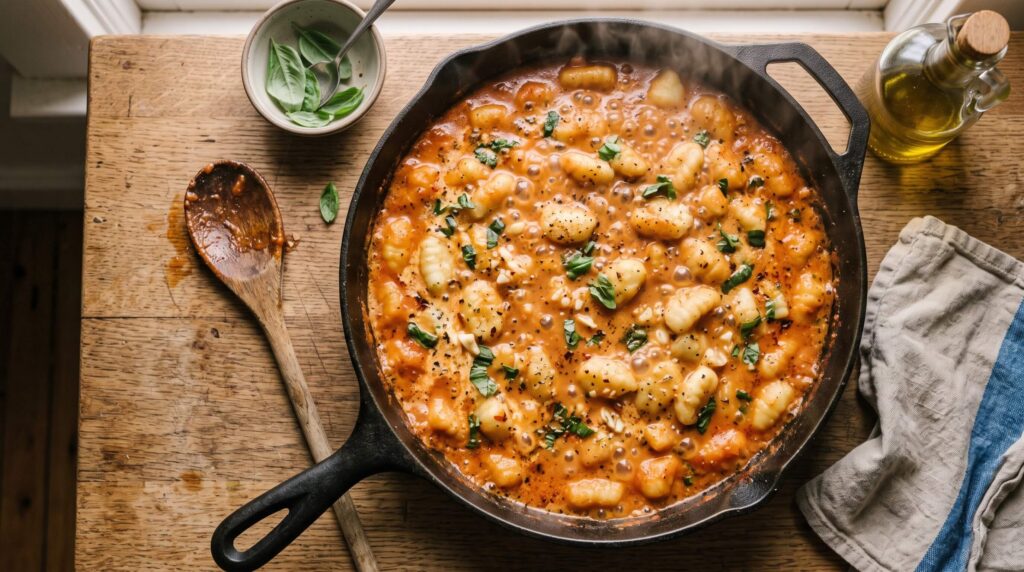
This is the part that turns a decent recipe into one you actually understand. Gnocchi is made primarily from potato and flour (or, in gluten-free versions, a flour substitute), both of which are dense in starch granules. When those granules hit hot liquid, they absorb water and swell — a process called gelatinization. As the gnocchi tumbles and simmers directly in the tomato-broth mixture, some of that swollen starch sloughs off the surface of each dumpling and disperses into the surrounding sauce.
Free starch molecules in a liquid do exactly what cornstarch does when you make a slurry: they trap water and thicken the surrounding liquid as the mixture heats. The difference is that here, the starch is coming from the food itself rather than a separate thickening agent, which is why the sauce clings to each piece of gnocchi rather than sitting as a thin layer underneath it.
Two things maximize this effect:
- Keep the liquid volume modest. Too much broth dilutes the starch concentration and you’ll never get that clingy texture, no matter how long you simmer.
- Stir occasionally, not constantly. Stirring redistributes surface starch into the sauce, but stirring too aggressively or too often can also break the gnocchi apart, releasing so much starch that the texture turns gluey instead of glossy.
If your sauce still looks thin after the gnocchi is fully cooked, resist the urge to add cornstarch — instead, let it sit off-heat for 2–3 minutes. The sauce continues to thicken as it cools slightly, since starch continues to absorb liquid even after the pot leaves the burner.
Instructions
- Sauté the aromatics. Heat olive oil in a large, deep skillet or Dutch oven over medium heat. Add the onion and cook for 2 minutes until softened, then add garlic and cook for 30 seconds until fragrant.
- Build the base. Pour in the crushed tomatoes and broth. Stir in oregano, red pepper flakes, a generous pinch of salt, and black pepper. Bring to a gentle simmer.
- Add the gnocchi. Stir in the gnocchi, making sure each piece is submerged in liquid. Cover and simmer, stirring occasionally — every 2 minutes or so — for 8–10 minutes if using shelf-stable gnocchi, or 4–6 minutes if using refrigerated. Gnocchi is done when it’s tender and floating near the surface.
- Stir in the cream and cheese. Reduce heat to low. Stir in the heavy cream (or cashew cream) and Parmesan until the sauce turns glossy and coats the back of a spoon.
- Finish with basil. Remove the pot from heat entirely, then fold in the torn fresh basil. Let the dish rest for 2 minutes to allow the sauce to thicken further.
- Serve. Divide among bowls, top with extra Parmesan and a few more basil leaves, and serve immediately.
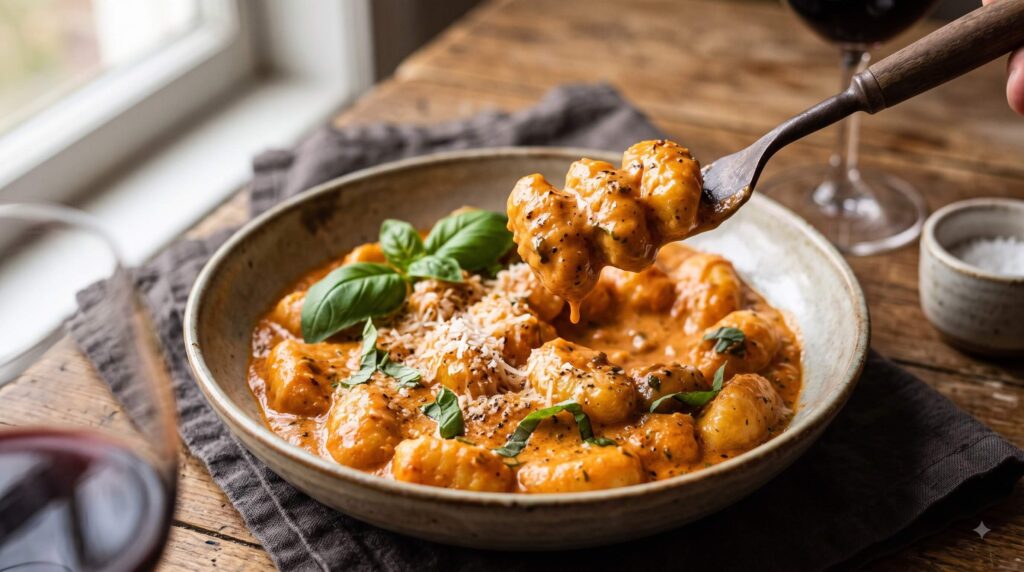
Herb Timing: Fresh Basil vs. Dried Basil
Basil is one of the few herbs where timing changes the outcome dramatically, and it comes down to what kind of flavor compounds it holds.
Fresh basil carries its flavor in volatile aromatic oils that break down quickly under sustained heat. Add it too early and those oils cook off, leaving behind a dull, slightly bitter, almost hay-like flavor instead of the bright, peppery-sweet note fresh basil is known for. That’s why this recipe calls for stirring fresh basil in only after the pot is off the heat — residual warmth releases its aroma without scorching it.
Dried basil works differently. Its flavor compounds are more concentrated and stable, but they’re locked inside dried plant cells that need time and moisture to rehydrate and release their flavor. Dried basil should go in early, alongside the oregano in step 2, so it has the full simmer time to bloom in the liquid.
If you only have dried basil on hand: use about 1 teaspoon in place of the ¼ cup fresh, added at the start of cooking rather than the end. If you want to use both, add a small pinch of dried early for depth and reserve fresh basil for the finishing garnish — this is a common technique in Italian home cooking to layer both a base flavor and a bright top note.
Dietary Alternatives
Gluten-Free Gnocchi
Most gluten-free gnocchi is made with rice flour, corn starch, or a gluten-free flour blend instead of wheat flour, blended with potato. The starch-release mechanics described above still apply — in fact, some gluten-free blends release starch even more readily than traditional wheat-based gnocchi, so you may find your sauce thickens slightly faster. Watch the simmer time closely, as gluten-free gnocchi can also turn mushy more quickly since it lacks the structural gluten network that helps traditional gnocchi hold its shape. Start checking for doneness a minute or two earlier than the times listed above.
Cashew Cream (Dairy-Free Substitution)
To replace the heavy cream, soak ¾ cup raw cashews in hot water for 15 minutes, then drain and blend with ½ cup fresh water until completely smooth — a high-speed blender works best. This makes slightly more than the ½ cup of heavy cream called for, which is intentional, since cashew cream is thinner than dairy cream and benefits from the extra volume to reach a similar consistency. Stir it in at the same step as you would heavy cream. For the Parmesan, a nutritional yeast and salt blend (roughly 3 tablespoons nutritional yeast plus a pinch of salt) approximates the salty, savory depth without dairy, though it won’t melt or turn glossy the same way real Parmesan does.
Kitchen Cleanup: Why One Pot Actually Means One Pot
The appeal of a one-pot recipe collapses fast if you still end up with a colander, a second saucepan for the sauce, and a cutting board full of dried-on tomato splatter. A few habits keep this dish to genuinely minimal cleanup:
- Measure liquids directly into the pot rather than in a separate measuring cup you’ll need to wash — pour broth straight from the carton against the pot’s inner wall to gauge the amount.
- Use the same spoon for sautéing, stirring, and serving; there’s no need for a dedicated stirring utensil when everything cooks in sequence.
- Deglaze as you go. Any browned bits from sautéing the onion and garlic dissolve directly into the tomato sauce once you add the liquid, so there’s no scrubbing a fond off the pot later — it becomes part of the dish.
- Let the pot cool before washing. Starch-thickened sauces set as they cool, which actually makes them easier to wipe out with a spatula before the pot even touches the sink, cutting down on scrubbing.
Nutrition Facts (Per Serving, Serves 4)
Based on the recipe as written with heavy cream and traditional potato gnocchi.
| Nutrient | Amount |
|---|---|
| Calories | 420 kcal |
| Total Fat | 15 g |
| Saturated Fat | 7 g |
| Cholesterol | 35 mg |
| Sodium | 890 mg |
| Total Carbohydrates | 58 g |
| Dietary Fiber | 5 g |
| Total Sugars | 9 g |
| Protein | 12 g |
| Calcium | 15% DV |
| Iron | 20% DV |
Values are estimates and will vary based on specific brands of gnocchi, broth, and cheese used. Using cashew cream in place of heavy cream reduces saturated fat to roughly 3g per serving and removes cholesterol entirely. Gluten-free gnocchi brands vary in carbohydrate content, so check individual packaging for exact figures.
Frequently Asked Questions
Why is my gnocchi turning out sticky or gummy? This almost always comes down to one of two things: overcooking or over-stirring. Once gnocchi is tender and floating, it’s done — every extra minute of simmering breaks down more starch and softens the exterior further, eventually turning individual pieces into a sticky mass. Stirring too frequently has a similar effect, since it physically knocks more starch loose than the sauce needs. Set a timer, check at the earliest suggested mark, and stir gently only every couple of minutes.
Can I fix gnocchi that’s already gone sticky? If it’s already happened, don’t try to rescue it by adding more liquid and cooking longer — that compounds the problem. Instead, remove the pot from heat immediately and let it rest uncovered for a few minutes. The residual starch will set up into a thick, cohesive sauce, and while the gnocchi won’t regain a fully distinct bite, the dish is still entirely edible and often tastes more like a rustic potato-tomato skillet than a failure.
Why did my sauce turn out thin instead of thick and clingy? Usually this means either too much liquid was used relative to the amount of gnocchi, or the gnocchi didn’t simmer long enough to release sufficient starch. Let the finished dish rest off-heat for a few extra minutes before serving — it will continue to thicken as it cools slightly.
Can I use frozen gnocchi? Yes, though it typically needs an extra 2–3 minutes of simmering since it starts from frozen rather than room temperature or chilled. Don’t thaw it first; add it directly to the simmering sauce.
Is it normal for gnocchi to float when it’s done? Yes — as the interior of each dumpling cooks through and any trapped air expands slightly, gnocchi becomes buoyant and rises to the surface. This is one of the most reliable visual cues for doneness, alongside a soft, yielding texture when pressed gently with a spoon.
Can I make this ahead of time? This dish is best fresh, since the starch-thickened sauce continues to firm up as it sits and gnocchi softens further with time. If you do have leftovers, store them in an airtight container in the refrigerator for up to 2 days, and reheat gently on the stovetop with a splash of extra broth or water to loosen the sauce back up.
What can I add to make this a full meal? A handful of baby spinach or chopped kale stirred in during the last 2 minutes of simmering wilts down easily and adds volume. For protein, cooked shredded chicken, white beans, or Italian sausage can be stirred in during step 4 alongside the cream.
Final Notes
The version of this recipe that works best is the one you adjust based on what’s actually in your kitchen — shelf-stable gnocchi from the pantry on a night you didn’t plan ahead, refrigerated gnocchi when you want it on the table in under ten minutes, cashew cream when you’re cooking for someone dairy-free. The method stays the same regardless: build a starch-friendly sauce, let the gnocchi do the thickening work it’s already built to do, and add fresh basil last so its flavor survives to the table.